Investor Education
Upfront Due Diligence Deposits: How Florida Borrowers Can Avoid Costly Financing Mistakes
Published By Luminary Private Lending
- Author:
- Ivan Padilla
- Reviewed By:
- Kevin Mazzola
- Published:
- October 5, 2026
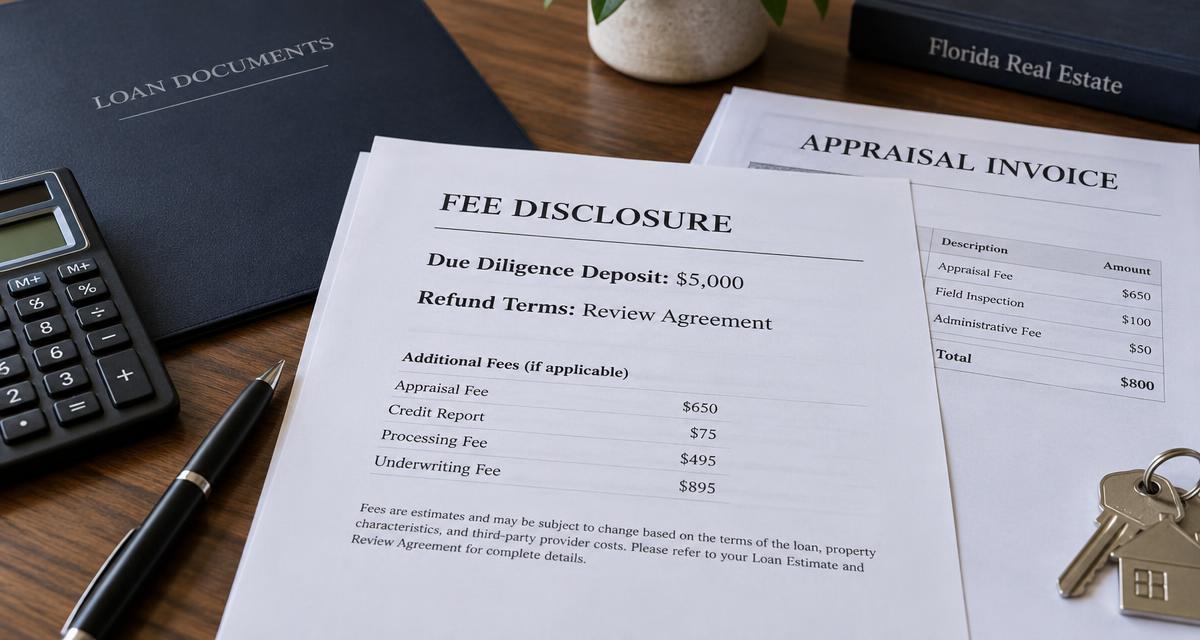
Know who receives your money, what work it covers and what happens if financing fails. A practical Florida guide to upfront deposits, written fee terms and independent verification.
Before paying an upfront due diligence deposit to a Florida lender or broker, verify the recipient, itemized services, written refund terms and actual funding status. A deposit does not automatically mean a scam, but paying for an unclear promise of financing can put your money and project deadline at risk. Luminary Private Lending does not require an upfront due diligence deposit; separate third party expenses and closing costs may still apply.
Quick Answer: Should You Pay a Lending Deposit?
Do not pay until you can explain who receives the money, what work it buys, when that work occurs and what happens if the loan does not close. An appraisal invoice for a defined service differs from a fee supposedly guaranteeing funding. “Credited at closing” does not mean “refundable if closing fails.” Read the written agreement and independently verify payment instructions.
Key Takeaways
- A fee’s name is not evidence of legitimacy or approval.
- Preliminary terms, an LOI and conditional approval may still leave material funding conditions unresolved.
- Refunds, unused funds and closing credits require separate written explanations.
- Business registration is not proof of lending authority, and licensing requirements depend on the activity and transaction.
- Pause when the recipient, service or terms are unclear; urgency is not a substitute for verification.
In This Guide
- Deposit and fee terminology
- What does the funding status mean?
- Seven warning signs
- Four hypothetical scenarios
- Sample deposit disclosure
- Checklist and downloadable worksheet
- Florida verification resources
- Luminary’s published no-deposit policy
- What to do if you already paid
- Frequently asked questions
What Is a Due Diligence Deposit in Real Estate Lending?
A due diligence deposit is an initial payment a lender or broker may request to cover evaluation of a proposed loan. Depending on the agreement, work may include property analysis, document review, legal review or outside reports. The label alone does not identify the recipient, deliverables, refund rights, unused-fund treatment or approval status.
| Term | What it may describe | What to confirm |
|---|---|---|
| Due diligence deposit | Funds for evaluating a financing proposal | Specific services, accounting and return of unused funds |
| Application fee | A charge for processing a request | What processing includes and whether it is refundable |
| Appraisal fee | Payment for a property valuation report | Provider, scope, amount and report access |
| Commitment fee | A charge associated with proposed lending commitments | Actual commitment, conditions, expiration and refund terms |
| Broker fee | Compensation for arranging or assisting with financing | Who pays, when earned and whether a deposit is separate |
Labels and legal treatment vary. A financing evaluation deposit is different from purchase-contract earnest money, which is paid under the purchase agreement and governed by that agreement’s escrow, contingency and default provisions. A loan deposit does not replace earnest money or protect it if financing fails.
Are All Upfront Loan Fees a Scam?
No. An appraisal, inspection or construction budget review may be a legitimate expense before closing. The FTC’s advance-fee loan guidance distinguishes real application or appraisal charges from demands for a payment that supposedly guarantees a loan. The practical question is: “Am I paying for a specific, documented service—or for an uncertain promise of funding?”
Consumer mortgage rules and business purpose financing rules can differ. Do not assume that every real estate loan follows the same fee process, or that calling a loan “business purpose” resolves every legal requirement.
Does an LOI or Conditional Approval Mean Funding Is Certain?
If the LOI includes title insurance at 125% of the loan, that is a policy amount requirement, not a deposit or a 25% fee. See our Florida 125% lender’s title insurance explanation and request the premium separately.
| Document or status | What it commonly indicates | What may remain |
|---|---|---|
| Preliminary terms | An initial indication based on limited facts | Lender review, valuation, title and documentation |
| Letter of intent (LOI) | Proposed terms and a possible path forward | Binding and nonbinding clauses, expiration and unresolved conditions |
| Conditional approval | A review subject to stated requirements | Satisfaction and verification of each condition |
| Commitment | A stated undertaking with defined terms | Conditions, deadlines, exceptions and closing requirements |
These are descriptive distinctions, not universal legal definitions. The document’s actual wording controls; a commitment may still be conditional. A broker’s enthusiasm is not evidence that a lender has reviewed the file.
Copyable funding-status question: “Has a lender reviewed my file, and what conditions remain before a funding decision?”
Also ask who makes the final decision, which lender is involved, how long proposed terms remain available and what changes could reduce the loan amount.
Seven Warning Signs Before You Send a Deposit
1. No itemized explanation
“Getting your file started” does not explain a payment of thousands of dollars. Request the work, provider, deliverable, timeline and applicable invoice for each charge.
2. Payment supposedly guarantees approval
“Wire the deposit and funding is guaranteed” should prompt careful verification. Payment does not resolve collateral value, title, borrower documents, project feasibility or final underwriting.
3. Vague refund terms
“You will get it back” is not a written policy. Ask what happens if the lender declines, valuation is lower, terms change, the loan is reduced, a purchase deadline passes or you withdraw. Identify what may be retained and why.
4. An unexplained funding process
Find out whether an identified lender has reviewed your scenario or the broker is still seeking one. Ask for milestones and the remaining funding conditions before paying.
5. Pressure before documents are available
A real deadline does not eliminate the need to review an agreement. Be wary of “you have one hour to wire” when the recipient or payment terms are still unclear.
6. Payment details do not match
If the agreement names one company and instructions name an individual or different business, stop and independently verify the explanation. Call a previously confirmed number, not a number supplied in a suspicious email.
7. Repeated unexplained fees
Additional “fund release,” “activation,” “insurance” or “funding authorization” payments deserve scrutiny. Request a complete written accounting and evidence of progress. A different label does not make an unsupported request safer.
Four Ways an Upfront Payment Can Go Wrong—or Be Clearly Documented
All scenarios below are hypothetical, not actual Luminary borrower transactions or statements about specific companies.
Example 1: $5,000 without defined services
A Florida investor seeks a $300,000 bridge loan. A broker requests $5,000, but the agreement does not identify the work, lender review or refund terms. After payment, the proposed lender is unavailable and the broker starts another search. The purchase deadline passes without funding. The deposit may be only part of the loss; purchase-contract consequences depend on that contract.
Before paying, the investor could have asked what the $5,000 buys, whether a lender reviewed the file, when services finish and what happens if the lender declines.
Example 2: A documented appraisal expense
A borrower receives an invoice naming the appraisal provider, property, service and cost. The borrower understands that a lower valuation may reduce the loan amount and that paying does not guarantee approval. The service is identifiable, but the financing risk remains. Ask whether you receive the report and whether another lender may accept it; acceptance or transferability is not guaranteed.
Example 3: A $7,500 closing credit that never materializes
A developer is told a $7,500 deposit will be credited at closing. The agreement says it is nonrefundable. The offered loan is too small and the transaction never closes. A closing credit has value only if closing occurs under the agreed terms; it is not a promise to return money if financing fails.
Example 4: A last-minute wire change
A familiar email address sends revised payment instructions because of an “accounting update.” Before wiring, the borrower calls a previously verified number to confirm the recipient, account details, amount and reason. Email familiarity alone does not verify an account change. See our Florida real estate wire fraud guide.
What Should a Written Deposit Disclosure Show?
Illustrative example only—not Luminary pricing, an actual agreement, a legal template or a recommended fee. Replace every field with the transaction’s verified terms and seek independent legal review where appropriate.
| Field | Hypothetical disclosure |
|---|---|
| Recipient and role | Example Finance LLC, proposed lender; independently verified contact |
| Amount | $2,000 evaluation deposit |
| Services | $800 appraisal; $700 legal review; $500 property/document review |
| Authorization | Written authorization before services are ordered; providers and invoices identified |
| Refund conditions | Unspent funds returned if declined or withdrawn; documented authorized completed work retained, subject to agreement and applicable law |
| Unused funds | Itemized accounting and return within the example’s stated 10 business days after file closure |
| Closing treatment | Remaining deposit credited only if closing occurs; no closing does not create a credit |
| Funding status | Conditional evaluation, not guaranteed financing |
The $800 + $700 + $500 allocation totals $2,000. These invented amounts and the 10 business day timeline are illustrative, not standard fees or a legal deadline. Ask how changed terms, disputed charges, service cancellation and provider refunds are handled.
Does “held in escrow” protect the deposit?
The phrase needs supporting details: legal escrow holder, account arrangement, governing agreement, authorized release conditions, accounting, refund rules and dispute procedure. Do not assume every evaluation deposit is an escrow deposit, that funds are automatically insured or that the recipient cannot release them.
Before You Pay: Borrower Checklist and One-Page Worksheet
- Identify the legal recipient and its role.
- Request services, providers, costs and deliverables in writing.
- Confirm lender review, decision maker and remaining conditions.
- Separate refundable amounts, nonrefundable authorized expenses and closing credits.
- Clarify reduced loans, changed pricing, missed deadlines and withdrawal.
- Confirm accounting and return of unused funds.
- Ask who pays the broker, when compensation is earned and whether this deposit is separate.
- Confirm escrow terms if escrow is claimed.
- Ask who owns or receives reports and whether reuse is possible.
- Independently verify payment instructions.
- Review the full project budget, not just the deposit.
Download the one-page “Before You Pay a Lending Deposit” worksheet (PDF).
A $4,000 deposit can reduce cash available for insurance, permits or construction contingencies. Delays can also affect contractor scheduling, taxes, insurance, existing loan maturity and earnest-money exposure. For a complex or substantial deposit, consider an independent attorney before signing.
A short fee clarification email you can copy
Subject: Written clarification of proposed financing deposit
Before I authorize payment, please confirm the legal recipient and role; itemized services, providers and deliverables; total amount and service timeline; whether a lender has reviewed my file and what conditions remain; refund rules if declined, withdrawn or terms change; closing-credit treatment; unused-fund accounting; and independently verifiable payment instructions. Please also identify broker compensation and any separate escrow arrangement. Send the agreement and relevant invoices for review.
What records should I keep?
Save signed agreements, initial and revised offers, invoices, payment confirmations, emails, messages, verification notes and accounting of completed work. Keep these privately; do not send sensitive banking details through an unverified channel.
How Can Florida Borrowers Independently Verify a Lender or Broker?
- Compare the legal name on the agreement with the website, business record and payment recipient.
- Confirm contact details independently; use a known number rather than instructions in a payment email.
- Review the actual activity, loan purpose and applicable licensing or registration requirements.
- Ask who decides funding, who receives compensation and what work the deposit buys.
- Resolve discrepancies before sending funds.
Florida Sunbiz business search can help check entity records. Business registration alone does not establish lending authority, approval or trustworthiness. The Florida Office of Financial Regulation (OFR) provides regulatory and licensing resources; consult it or qualified counsel about requirements for the actual activity.
NMLS Consumer Access may help verify mortgage companies and professionals whose activities require NMLS licensing or registration. It is not the sole test for every business purpose lender. A listing does not guarantee a loan or validate payment instructions, and absence alone does not establish fraud; investigate the applicable requirements.
When Should You Pause Payment?
- Unclear recipient → independently verify the legal entity and payment destination.
- Undefined service → request the agreement, scope, deliverables and invoices.
- Unresolved refund or funding terms → delay payment until the written answers are understood.
- Changed wire details or suspected deception → stop, confirm through a trusted channel and contact your bank if money was sent.
This is a verification guide, not a recommendation to breach a signed contract or an assurance that stop-payment or recovery is available.
Luminary’s Published Upfront Due Diligence Deposit Policy
Luminary Private Lending does not require an upfront due diligence deposit for its Florida business purpose real estate financing. Separate third party services, such as an appraisal, survey or inspection, and closing costs may still apply depending on the property and transaction. Confirm the provider, scope, amount and payment timing in writing.
No due diligence deposit does not mean no costs, guaranteed approval or an unconditional commitment. Every financing request remains subject to review and the final written agreement.
This section publishes the company policy supplied for this article; it is not independent evidence about other lenders. The loan program policy explanation also describes its scope. Discuss any requested fee directly with the Luminary team.
What Should You Ask for Your Florida Financing Scenario?
Whether your property is in Orlando, Tampa, Jacksonville, Miami or elsewhere in Florida, match questions to the actual loan.
- Bridge financing: What supports value, is the amount preliminary, what title conditions remain and does the timeline fit the purchase or payoff deadline?
- Construction financing: Has the budget been reviewed, what plans and permits remain, how are draws released and what conditions precede closing?
- Vacant land financing: What valuation, access, zoning and collateral documents remain, and what could change the offered amount?
What If You Already Paid a Suspicious Deposit?
Act promptly. Save the agreement, invoices, correspondence and payment records. Request a written account of services performed and funds used. Contact your bank or payment provider immediately and ask about recall, reversal or other recovery options; availability depends on payment method, timing and circumstances and is not guaranteed.
Report suspected scams at FTC ReportFraud. For suspected online or wire fraud, consider a complaint at the FBI Internet Crime Complaint Center (IC3). The FBI’s business email compromise guidance explains independent payment verification and immediate bank contact. A contract dispute is not automatically fraud; an independent attorney can evaluate the agreement and available options.
Frequently Asked Questions About Upfront Lending Deposits
Is a due diligence deposit always a red flag?
No. Scrutinize it when services, recipient, refund terms or financing status are unclear. A documented service expense differs from an unexplained payment for a promise of funding.
Can a legitimate lender require an appraisal fee before closing?
Yes. Ask who supplies the appraisal, its cost, report access and what happens if value does not support the requested financing. Payment does not guarantee approval.
Does paying a deposit guarantee loan approval?
No. Funding may still depend on underwriting, collateral value, title, documents and other conditions. Request the actual funding status in writing.
Is the deposit refundable if the lender denies the loan?
That depends on the written agreement and applicable law. Do not assume the entire amount is refundable merely because the transaction fails to close.
What does “credited at closing” mean?
It generally means the agreed payment is applied toward specified costs at closing. It does not automatically require a refund if closing never occurs.
Does Luminary charge an upfront due diligence deposit?
No. Luminary does not require an upfront due diligence deposit. Separate third party expenses and closing costs may still apply, and approval is not guaranteed.
Is Sunbiz or NMLS verification enough?
No. Check identity, applicable authority, contact information, agreement, recipient and funding process together. Business registration is not a financial-services license.
Editorial Methodology and Review
Author: Ivan Padilla, Director of Growth and Real Estate Lending Specialist, part of the Luminary Private Lending team. Reviewer: Kevin Mazzola, Founder. Meet the team.
Published October 5, 2026. This guide combines Luminary’s stated company policy, the public FTC, FBI, Sunbiz, OFR and NMLS resources linked above, and hypothetical examples. It is not original research or a report of actual borrower outcomes. Public consumer guidance is not presented as a complete legal rulebook for business purpose financing.
Review schedule: Kevin Mazzola is assigned to review the policy, resource links and factual statements quarterly, with the next review planned for January 5, 2027, and sooner if policy or relevant guidance changes. An update date should change only after a substantive review; a scheduled review is not evidence that it has occurred.
Educational information only, not legal or individualized financing advice. Agreements, requirements and expenses vary by transaction.
Discuss Your Florida Financing Scenario With Luminary
Before paying for a financing proposal, understand the terms and the path to closing. Luminary does not require an upfront due diligence deposit. Bring the property details, requested amount, current debt, use of funds and deadline.
Discuss your Florida financing scenario or call (321) 621-1280 for the next steps. Financing remains subject to review and the final agreement.
Related Florida Lending Resources
Keep Reading
Latest Insights
Keep exploring Florida private lending insights.

Investor Education
What Does 125% Lender’s Title Insurance Mean? Florida Private Lending Guide
A 125% lender’s title insurance requirement means the policy amount equals 125% of the loan principal. It does not mean the borrower receives 25% more money or pays a 25% fee. On a $1,950,000 loan, 125% coverage equals $2,437,500; actual protection depends on the policy terms.

Investor Education
Can You Get a Private Real Estate Loan Without Tax Returns in Florida?
Tax returns do not always reflect an investor's real financial strength. This Florida guide explains how asset-based private lenders evaluate property value, equity, loan-to-value, liquidity, use of funds and exit strategy instead of conventional income documentation.

Investor Education
Can a Newly Formed LLC Qualify for a Private Real Estate Loan in Florida?
A newly formed LLC may still qualify for private real estate financing in Florida. This guide explains what asset-based lenders review instead of operating history: property value, equity, liens, liquidity, the principals, documentation and the exit strategy.

Investor Education
Title Issues & Code Violations: Can They Get a Private Real Estate Loan Denied in Florida?
Strong equity and a supportive appraisal do not guarantee a closing. This Florida guide explains how title defects, recorded liens, municipal code liens, open permits and unpermitted work affect private lending, which issues are usually curable, what documentation to send up front, and why lien position matters as much as value.

Investor Education
Can an LLC Get a Real Estate Loan Without Personal Credit? A Florida Private Lending Guide
An LLC real estate loan without personal credit as the deciding factor is possible with asset-based private lenders. This Florida guide covers what lenders review instead, LTV math with worked scenarios, new-LLC and free-and-clear situations, the difference between a credit pull and a personal guarantee, and a borrower document checklist.
Investor Education
Can You Borrow Against a Free-and-Clear Property in Florida?
A 2026 guide to unlocking equity in Florida real estate you own free and clear: first lien position, LTV sizing tables, worked residential, commercial, multifamily, and land examples, plus a private loan vs. cash-out refinance vs. HELOC comparison.
Investor Education
What Is a Balloon Payment? A Complete Guide for Real Estate Investors in Florida
A balloon payment is a large final payment due at the end of a short term loan. Here is how balloon loans work, which programs use them, real Florida examples, the risks, and how investors plan an exit strategy before borrowing.

Investor Education
Purchase Price Higher Than the Listing? Here’s What Could Really Be Going On
A higher contract price can be legitimate, but a material unexplained difference deserves independent verification. This guide explains how lenders can reconcile the listing, contract, appraisal, title and closing figures.

Investor Education
How Unclear Payoff Statements and Property Liens Can Delay a Private Real Estate Loan Closing
An unclear payoff or an unresolved lien can stall a Florida private loan even when the property has equity. This guide explains payoff statements, lien types, combined loan to value on second mortgages, paying liens at closing and how to prevent delays.

Investor Education
What Happens If a Property Appraises Lower Than Expected?
A low appraisal changes the numbers, not always the deal. How a lower-than-expected value affects LTV, loan proceeds, the appraisal gap, construction and refinance requests, and what Florida investors can do next.

Investor Education
What Do Private Lenders Look for in an Appraisal?
A private lender reads an appraisal for value, comparable sales, condition, marketability, zoning, and projected value at completion. Here are the 12 things Florida borrowers should know, with worked LTV, CLTV, and LTC examples.

Investor Education
LTV vs. LTC vs. ARV: What's the Difference in Real Estate Lending?
LTV measures the loan against property value, LTC measures it against total project cost, and ARV estimates value once the work is done. Here is how Florida private lenders use all three, with one deal calculated three ways.