Investor Education
What Does 125% Lender’s Title Insurance Mean? Florida Private Lending Guide
Quick answer
A 125% lender’s title insurance requirement means the policy amount equals 125% of the loan principal. It does not mean the borrower receives 25% more money or pays a 25% fee. On a $1,950,000 loan, 125% coverage equals $2,437,500; actual protection depends on the policy terms.
Published By Luminary Private Lending
- Author:
- Ivan Padilla
- Reviewed By:
- Kevin Mazzola
- Published:
- October 7, 2026

Key Takeaways
- A $1,950,000 loan stays a $1,950,000 loan.
- 125% of that amount is a $2,437,500 title policy amount.
- The $487,500 difference is not additional proceeds.
- 125% coverage is not a 25% fee; the premium is separate.
- A larger policy amount does not expand every covered risk or guarantee a claim payment.
What Is 125% Lender’s Title Insurance?
125% lender’s title insurance is a lender requirement in which the title insurance policy amount is set at 125% of the underlying loan amount. If a Letter of Intent (LOI) says “Lender’s Title Insurance: 125% of Loan Amount,” it identifies a proposed insurance requirement, not an offer of 25% more money.
A lender’s title insurance policy protects the insured lender’s mortgage interest against covered title risks. These can involve defects affecting ownership, recording, mortgage validity or priority, or competing claims, depending on the issued policy. It is not a guarantee that every lien or dispute is covered.
An owner’s policy protects the property owner’s interest. Buying a lender’s policy does not automatically give the borrower an owner’s policy. Review both separately with the closing professional.
How Do You Calculate 125% of the Loan?
Loan amount × 1.25 = required 125% policy amount.
$1,950,000 × 1.25 = $2,437,500.
$2,437,500 − $1,950,000 = $487,500 of additional policy amount.
The borrower still borrows $1,950,000 in this hypothetical example. Net cash received may be less after agreed payoffs, reserves and closing expenses. Neither the $2,437,500 policy amount nor the $487,500 difference is cash available to the borrower.
| Loan principal | 125% policy amount | Additional policy amount |
|---|---|---|
| $250,000 | $312,500 | $62,500 |
| $500,000 | $625,000 | $125,000 |
| $1,000,000 | $1,250,000 | $250,000 |
| $1,950,000 | $2,437,500 | $487,500 |
| $5,000,000 | $6,250,000 | $1,250,000 |
All amounts above are illustrative calculations, not loan offers, premium quotes or statements of program limits. The same multiplication works at each loan size.
100% vs. 125%: What Actually Changes?
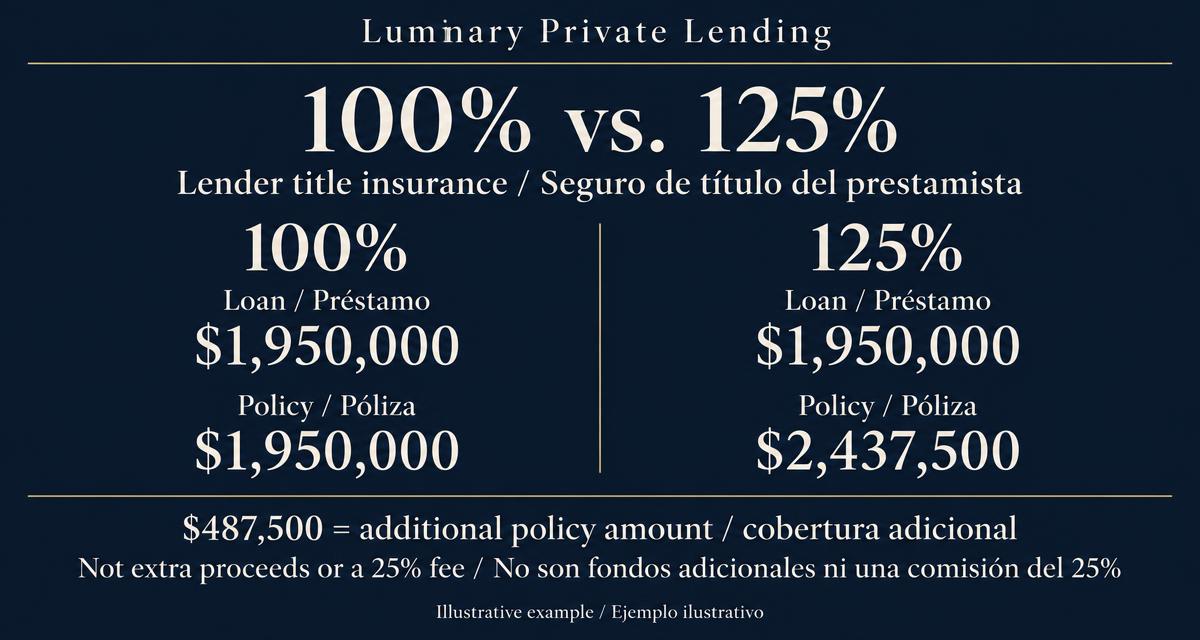
| Item | 100% requirement | 125% requirement |
|---|---|---|
| Loan principal | $1,950,000 | $1,950,000 |
| Policy amount | $1,950,000 | $2,437,500 |
| Amount above principal | $0 | $487,500 |
| Extra proceeds from coverage | None | None |
| Premium | Separate quote | Separate quote |
| Automatic increase in principal | No | No |
A higher policy amount changes the stated insurance limit. It does not erase exceptions, create automatic recovery or convert an uncovered loss into a covered loss. Insurer liability can be limited by the actual covered loss and other policy provisions.
Loan Amount vs. Policy Amount vs. Premium
- Loan amount: the financing principal stated in the loan documents.
- Policy amount: the stated amount of insurance, subject to the policy’s terms.
- Premium: the price charged for the insurance, calculated separately under applicable rules.
For the example above, $1,950,000 is principal and $2,437,500 is the policy amount. The premium is not given by either number or their $487,500 difference. Obtain an itemized quote rather than treating coverage as a closing charge.
Is 125% Title Insurance a 25% Fee?
No. A 125% policy requirement does not mean you pay 25% of the principal as an insurance fee. A higher insured amount may affect the premium, but not through the mistaken assumption that the borrower owes the additional coverage amount.
Ask the title company to separate the base premium, endorsements, search or examination charges, settlement charges, recording charges and any applicable credits. Not every title related charge is an insurance premium.
Does 125% Title Insurance Increase My Monthly Payment?
No, not by itself. Interest and payments follow the actual note, interest method, balance and agreed terms, not the face amount of the title policy. If the parties separately agree to finance closing expenses, that financing may change the balance and payment. Do not confuse that separate decision with the coverage percentage.
Why Would a Private Lender Require More Than 100%?
A lender may want a stated policy amount above the original principal because its exposure under the loan documents can evolve. Accrued interest, permitted protective advances or certain expenses may be relevant to that assessment. Whether any particular amount is insured depends on the applicable policy and loss provisions.
Title insurance is not general default insurance. A borrower’s missed payment, a decline in property value, unfinished construction or an enforcement expense does not automatically become a covered title claim. A 25% cushion in policy amount is not a blanket promise to reimburse default interest, legal expenses or every protective advance.
For Florida construction loans, ask how future advances, draws and potential construction liens are handled. For second mortgage financing, confirm the insured lien position and treatment of the existing first mortgage. A larger policy amount alone does not resolve either issue.
Is 125% a Florida Legal Requirement?
Do not treat it as a universal mandate. Florida has rules governing title insurance rates and policy issuance, including Rule 69O-186.003. A particular lender’s 125% funding condition is distinct from saying every Florida borrower must buy that coverage. Have the title insurer or qualified Florida counsel confirm the applicable rule and form for the transaction.
The Florida Department of Financial Services title insurance overview explains the insurance and premium framework. Florida rates, eligibility for reissue treatment, simultaneous issuance of owner’s and lender’s policies, endorsements and the amounts insured can affect the quote. Do not assume a discount, a fixed nominal lender premium or the same price for every closing.
Can a Borrower Negotiate 125% Down to 100%?
You can ask, but approval is not guaranteed. The lender may keep 125% as a closing condition. Ask early, explain the reason for the request and obtain any approved change in writing. Do not instruct the title company to lower the policy unilaterally.
Is the Requirement a Red Flag?
Not by itself. The concern is whether the actual loan, insurance requirement and charges are clearly disclosed and consistent. Pause if someone labels the $487,500 coverage difference as a required fee, cannot identify the insurer, or substitutes vague promises for a written commitment and quote.
Florida Closing Checklist
- Confirm the note principal and the required policy amount in writing.
- Identify the insured lender, insurer and issuing title agent.
- Review the title commitment’s requirements and exceptions; a commitment is not the final issued policy.
- Ask what policy form and endorsements will be issued and what risks remain excluded.
- Confirm lien priority, legal description, surveys and any future advance requirements.
- Request an itemized premium and closing quote, including eligible credits.
- Confirm who pays each charge under the contract and closing agreement.
- Ask what happens to the insurance requirement if the approved loan amount changes.
- Have unresolved insurance or legal questions reviewed before signing.
For related preparation, read our Florida payoff statements and property liens guide and upfront due diligence deposit guide. Policy amount, payoff amount and an evaluation deposit are different figures serving different purposes.
What We Explain to Borrowers at Luminary Private Lending
Our explanation separates three lines on the closing conversation: what you borrow, what the title policy states and what the insurance actually costs. For a proposed 125% requirement, we show the multiplication first, then direct premium and coverage questions to the issuing title professional. This is the explanatory approach for this guide, not a claim about measured borrower outcomes or a replacement for the policy.
When reviewing an LOI, compare the proposed amount with the final note, title commitment, insurer quote and settlement statement. An LOI is not the issued policy and is not necessarily an unconditional commitment to fund. Ask the lender and closing agent to reconcile inconsistent figures before closing.
Luminary Private Lending provides private real estate financing for qualifying Florida transactions. Explore Florida bridge loans, vacant land financing and our Florida private lending service areas. County title records and the actual property documents matter more than a general coverage percentage.
Frequently Asked Questions
What does 125% lender’s title insurance mean?
The required policy amount equals the loan principal multiplied by 1.25. For a $1,950,000 loan, that is $2,437,500. This is an insured amount, not the premium or additional proceeds.
Is 125% title insurance a 25% fee?
No. The extra 25% refers to policy amount. The actual premium and other title charges must be quoted separately by the title company.
Does the policy amount increase my loan or monthly payment?
Not by itself. Principal and payments follow the loan documents. If separately agreed closing expenses are financed, that financing can affect the balance and payment; the coverage percentage alone does not.
Does Florida require every lender to use 125%?
No. Do not confuse a lender’s transaction requirement with a universal Florida mandate. Confirm the applicable Florida rule, policy form and underwriting requirements with the title company.
Can I ask for 100% instead of 125%?
Yes, but the lender may maintain 125% as a funding condition. Obtain any approved change in writing before the title company issues the policy.
Does lender’s title insurance protect the owner?
A lender’s policy protects the insured lender’s interest. An owner’s policy protects the owner’s interest. They are different policies with their own terms and exclusions.
Who pays the lender’s title insurance premium?
Allocation depends on the contract and closing arrangements. Ask the closing agent to identify the payer, actual premium, endorsements and other charges on the settlement statement.
Does 125% coverage guarantee payment of every default expense?
No. Title insurance addresses covered title losses, not every financial loss or borrower default. The policy, exceptions, exclusions, conditions and endorsements control.
The Bottom Line
On a $1,950,000 private loan, 125% lender’s title insurance equals a $2,437,500 policy amount. The borrower still has a $1,950,000 loan; the additional $487,500 represents policy amount, not additional loan proceeds or a 25% fee. Actual protection and cost depend on the policy and the title company’s quote.
Sources, Author and Review Status
- Florida Administrative Code, Rule 69O-186.003: title insurance rates.
- Florida DFS: title insurance overview.
- Florida Office of Insurance Regulation: title insurance resources and forms.
Author: Ivan Padilla, Director of Growth and Real Estate Lending Specialist, part of the Luminary Private Lending team. Meet the Luminary team. Editorial reviewer: Kevin Mazzola, Founder.
Published and last updated: October 7, 2026. This guide uses the supplied lending explanation, public Florida resources and transparent hypothetical calculations. A specialist insurance or legal review has not been documented; Kevin’s editorial attribution is not a title insurance credential or confirmation of such a review. Ask a qualified Florida title professional or attorney about your policy.
Review workflow: before adding a “Last Reviewed” date or a specialist credential, record the actual reviewer, qualifications, review date and corrections. Revisit this guide when relevant rules, policy forms or company requirements change; do not refresh the date merely for appearance.
Educational information only, not legal, insurance or individualized financial advice. Coverage, underwriting and financing remain subject to the final documents.
Discuss Your Florida Real Estate Financing
Bring your property details, requested loan amount, timeline and title commitment. Contact Luminary Private Lending or call (321) 621-1280. Confirm the actual insurance requirement and costs before closing; financing is subject to review and approval.
Related Florida Lending Resources
Keep Reading
Latest Insights
Keep exploring Florida private lending insights.

Investor Education
Can an LLC Get a Real Estate Loan Without Personal Credit? A Florida Private Lending Guide
An LLC real estate loan without personal credit as the deciding factor is possible with asset-based private lenders. This Florida guide covers what lenders review instead, LTV math with worked scenarios, new-LLC and free-and-clear situations, the difference between a credit pull and a personal guarantee, and a borrower document checklist.

Investor Education
Title Issues & Code Violations: Can They Get a Private Real Estate Loan Denied in Florida?
Strong equity and a supportive appraisal do not guarantee a closing. This Florida guide explains how title defects, recorded liens, municipal code liens, open permits and unpermitted work affect private lending, which issues are usually curable, what documentation to send up front, and why lien position matters as much as value.
Investor Education
What Is Cross Collateralization in Private Lending? A Complete Guide for Real Estate Investors
Cross collateralization lets investors combine equity from several properties to secure one loan. Here is how the collateral package works, who it fits, the risks, lender requirements, and a Florida example that closed in ten days.

Investor Education
Can You Get a Private Real Estate Loan Without Tax Returns in Florida?
Tax returns do not always reflect an investor's real financial strength. This Florida guide explains how asset-based private lenders evaluate property value, equity, loan-to-value, liquidity, use of funds and exit strategy instead of conventional income documentation.

Investor Education
Can a Newly Formed LLC Qualify for a Private Real Estate Loan in Florida?
A newly formed LLC may still qualify for private real estate financing in Florida. This guide explains what asset-based lenders review instead of operating history: property value, equity, liens, liquidity, the principals, documentation and the exit strategy.
Investor Education
What Do Private Lenders Look for in an Appraisal?
A private lender reads an appraisal for value, comparable sales, condition, marketability, zoning, and projected value at completion. Here are the 12 things Florida borrowers should know, with worked LTV, CLTV, and LTC examples.
Investor Education
What Is a Balloon Payment? A Complete Guide for Real Estate Investors in Florida
A balloon payment is a large final payment due at the end of a short term loan. Here is how balloon loans work, which programs use them, real Florida examples, the risks, and how investors plan an exit strategy before borrowing.
Investor Education
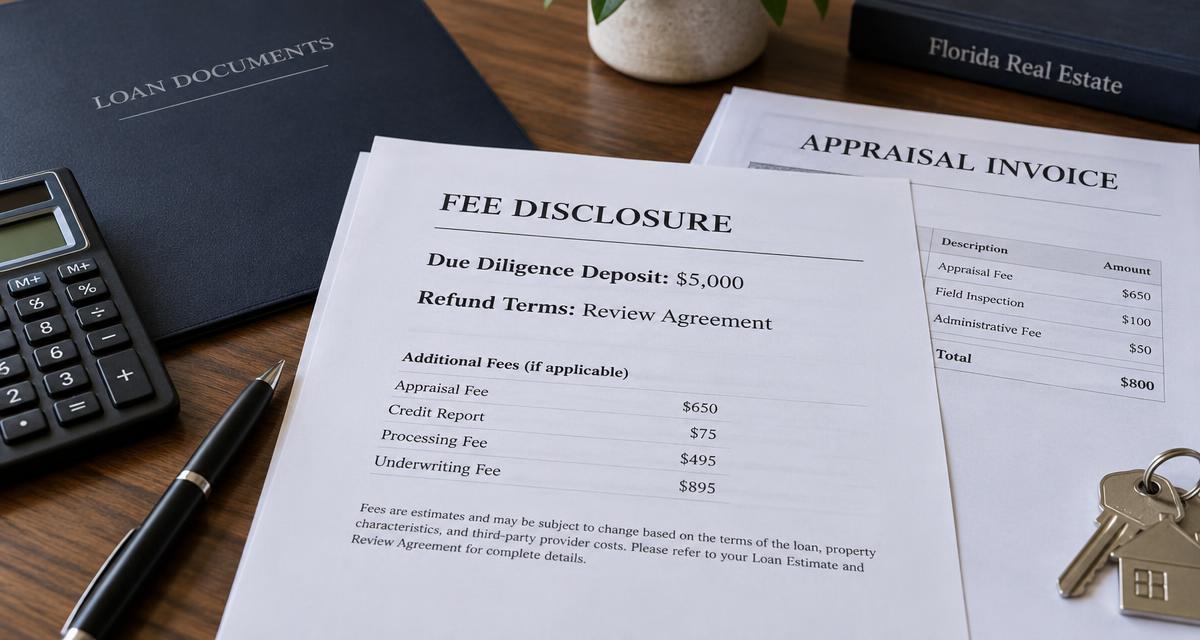
Upfront Due Diligence Deposits: How Florida Borrowers Can Avoid Costly Financing Mistakes
Know who receives your money, what work it covers and what happens if financing fails. A practical Florida guide to upfront deposits, written fee terms and independent verification.

Investor Education
How Unclear Payoff Statements and Property Liens Can Delay a Private Real Estate Loan Closing
An unclear payoff or an unresolved lien can stall a Florida private loan even when the property has equity. This guide explains payoff statements, lien types, combined loan to value on second mortgages, paying liens at closing and how to prevent delays.
Investor Education
Can You Borrow Against a Free-and-Clear Property in Florida?
A 2026 guide to unlocking equity in Florida real estate you own free and clear: first lien position, LTV sizing tables, worked residential, commercial, multifamily, and land examples, plus a private loan vs. cash-out refinance vs. HELOC comparison.

Investor Education
LTV vs. LTC vs. ARV: What's the Difference in Real Estate Lending?
LTV measures the loan against property value, LTC measures it against total project cost, and ARV estimates value once the work is done. Here is how Florida private lenders use all three, with one deal calculated three ways.

Investor Education
What Is an Interest Reserve in a Construction Loan? A Complete Guide for Builders and Contractors
An interest reserve covers construction loan interest from loan proceeds while the property produces no income. Here is how lenders size it, how it interacts with the draw schedule, and what happens when a build runs long.