Investor Education
What Does a Personal Guarantee Mean on an LLC Real Estate Loan in Florida?
Published By Luminary Private Lending
- Author:
- Ivan Padilla
- Reviewed By:
- Kevin Mazzola
- Published:
- November 12, 2026

A personal guarantee is an individual's agreement to cover specified obligations of an LLC borrower. Owning a Florida LLC does not alone make you liable for its debts, but signing a guarantee can. The signed terms set the scope.
Quick Answer
A personal guarantee on an LLC real estate loan is an individual's agreement to cover specified borrower obligations. In Florida, owning an LLC does not alone make you responsible for its debts, but signing a guarantee can create personal liability. The signed terms determine its scope.
An LLC can own property and borrow money, but its owner may still be asked to guarantee the loan personally. For Florida investors, qualifying with the property does not mean the individuals behind the LLC carry no personal liability.
Key Takeaways
- Borrower: the LLC signs the loan and owes the debt.
- Collateral: the property secures the loan through a recorded mortgage.
- Guarantor: an individual who signs a separate promise to cover specified obligations.
- Exposure: set by the guarantee's wording, caps, and whether it is joint and several.
- Release: usually requires the guarantee's own conditions and the lender's written release, not just leaving the LLC.
Does an LLC Protect You From Personal Liability for a Loan?
In Florida, an LLC's debts belong to the company. A member or manager is not personally liable for a company obligation solely because of owning or managing it (Florida Statutes §605.0304). Signing a personal guarantee creates a new, separate obligation: you can sign loan documents on behalf of the LLC and also sign a guarantee in your own name.
In plain text: the LLC is the borrower, the property is the collateral, and the guarantor is the individual the lender may also pursue under the guarantee's terms.
Is a Personal Guarantee Required?
It depends on the lender and the transaction. Collateral quality, leverage, project risk and the borrower's track record all influence whether a guarantee is requested and how broad it is. Luminary sets its requirements per loan; ask early whether your request would require a guarantee, and confirm the answer in the term sheet and proposed documents. If you are working with a newly formed LLC, expect this question to come up.
Is a Personal Guarantee the Same as a Personal Credit Check?
No. They address different things.
| Item | What it addresses |
|---|---|
| Personal credit review | How the lender evaluates an individual's credit history |
| Personal guarantee | What an individual agrees to be responsible for |
| Mortgage | What property secures the loan |
| Personal financial statement | What an individual reports about their finances |
A lender may focus on property value and still require a guarantee. Saying credit is not the main factor does not mean a loan is nonrecourse. See LLC loans without personal credit.
Recourse vs. Nonrecourse: A Precise Comparison
| Recourse loan | Nonrecourse loan | |
|---|---|---|
| Repayment exposure | Borrower or guarantor may owe the remaining balance | Generally limited to the property |
| Collateral remedy | Foreclosure plus a possible deficiency claim | Foreclosure |
| Carve-out liability | Broad liability already exists | Personal if a listed carve-out act occurs |
"Nonrecourse" never means no possible personal liability. Read it together with the carve-out list.
Are All Personal Guarantees the Same?
No. Scope depends entirely on the wording.
| Guarantee type | Covered obligation | Possible trigger | Provisions to review |
|---|---|---|---|
| Full payment guarantee | All unpaid debt, interest and specified costs | LLC payment default | Whether legal fees and enforcement costs are included |
| Limited guarantee | A set dollar amount, percentage or specific obligation | Default, up to the cap | Whether the cap includes interest and expenses |
| Completion guarantee | Finishing the project or covering specified costs | Stalled work, overruns, delays | How completion and overruns are defined |
| Nonrecourse carve-out guarantee | Losses from acts such as fraud or unauthorized transfers | A listed prohibited act | The carve-out list and any springing full recourse trigger |
One transaction can include several guarantee types at once.
Does the Lender Have to Foreclose Before Pursuing the Guarantor?
Do not assume it does. The key distinction is the type of promise:
- Guarantee of payment: the guarantor promises to pay when the borrower does not. Many such guarantees allow the lender to demand payment from the guarantor without first foreclosing or suing the LLC.
- Guarantee of collection: the lender generally must first try to collect from the borrower or collateral before turning to the guarantor.
Florida courts generally enforce a guarantee according to its written terms, and Florida's statute of frauds requires a promise to answer for another's debt to be in writing and signed (Florida Statutes §725.01). Ask a Florida attorney which category your document falls into and whether any notice or demand is required first.
Your Home, Your Assets, Your Credit and Your Spouse
Does a personal guarantee put a lien on my home?
A guarantee is a contract, not a mortgage. It does not by itself encumber your home. A lien would generally require a separate recorded mortgage or pledge, or a later court judgment that is recorded (see Florida Statutes §222.01 on homestead and judgment liens). Florida's constitutional homestead protection (Art. X, §4) may limit enforcement against a qualifying home. These rules have important exceptions, so have Florida counsel review your situation.
What personal assets could be exposed?
Liability and collectability are different questions. A guarantee can make you liable, but what a creditor can actually collect depends on exemptions, how assets are titled and applicable law. Avoid both extremes: not every asset is reachable, and not every asset is protected.
Does a personal guarantee affect my credit?
Separate four events: signing the guarantee, a credit inquiry when you apply, any reporting of the account, and reporting after a default or judgment. Practices vary by lender; ask how yours handles each before you sign.
Does my spouse have to sign?
Guaranteeing repayment is different from signing documents because a spouse has an interest in collateral, such as jointly owned or homestead property. A spouse may be asked for one, both or neither. This needs legal review rather than a universal yes or no.
An Annotated, Hypothetical Guarantee Clause
"Guarantor absolutely, unconditionally and irrevocably guarantees, jointly and severally, the full and punctual payment of all Obligations, and this is a continuing guaranty of payment and not of collection."
- Unconditional: few or no preconditions before the lender can demand payment.
- Jointly and severally: each guarantor may be pursued for the whole amount.
- Payment, not collection: the lender need not exhaust the LLC or collateral first.
- Continuing: may cover future advances, extensions or modifications unless limited.
Illustrative only. This is not language from Luminary's documents.
Hypothetical Florida Examples
Example 1: Full payment guarantee
An LLC borrows $600,000 against a Florida investment property, and its owner signs a full payment guarantee. The project stalls and defaults.
| Item | Amount |
|---|---|
| Total enforceable debt and expenses | $650,000 |
| Net proceeds credited against the debt | $520,000 |
| Remaining unpaid balance | $130,000 |
The lender may pursue the remaining $130,000 from the guarantor, depending on the guarantee, applicable law and any defenses. Selling or surrendering the property does not necessarily satisfy a personal guarantee.
Example 2: Limited guarantee with a cap
Same facts, but the guarantee is capped at $100,000, and the cap is written to include interest and enforcement expenses. The guarantor's maximum exposure is $100,000, not $130,000. If the cap instead excluded interest and expenses, those amounts could be added on top of the $100,000.
Example 3: Construction cost overrun
A ground-up project runs over budget and the draws remaining will not finish it. Under a completion guarantee, the question may be whether the guarantor must fund the gap so the building is finished. Under a repayment guarantee, the question is usually only whether the loan is repaid at maturity. The documents decide which applies. See when construction takes longer than the loan term and balloon payments.
All examples are simplified and hypothetical.
If There Are Two Owners, Does Each Guarantee Half?
Not automatically. Ownership percentages do not determine guarantee liability. Under a joint and several guarantee, either signer can be liable for the whole obligation, and a private agreement between partners to split losses does not limit the lender's rights. Confirm whether each guarantor's obligation is capped, limited to an ownership percentage, joint and several, or subject to separate release conditions.
Step by Step Guarantee Release Checklist
- Read the guarantee's termination and release clauses before closing.
- Identify every condition: payoff, sale, refinance, substitute guarantor or performance milestone.
- Request the lender's written release of the guarantor when conditions are met.
- Check for surviving obligations, such as environmental or carve-out indemnities.
- Remember that a recorded mortgage satisfaction releases the property, not necessarily the guarantor.
Selling your LLC interest or resigning as manager generally does not change your agreement with the lender. Related: lien priority and payoff statements.
What Should You Review Before Signing?
- What am I guaranteeing? Payment, completion, specified losses or another obligation?
- Is there a cap? Does it include interest, legal fees and enforcement costs?
- When can the lender demand payment? Must it take other steps first?
- What if the loan is extended or modified? Does the guarantee continue without new consent?
- What if another owner also guarantees? Separate, proportional or joint and several?
- How do I get released? Exact conditions and documents.
Can You Negotiate a Personal Guarantee?
You can ask whether the lender will consider a liability cap, clear release conditions or a narrower scope. Availability depends on the lender, collateral, leverage, project risk and borrower profile. Strong equity does not automatically remove the need for a guarantee. Weigh the guarantee together with the rate, fees and exit strategy.
Frequently Asked Questions
Does an LLC protect me from personal liability on a loan?
Generally yes for the LLC's own debts. Florida Statutes §605.0304 says a member or manager is not personally liable for company obligations solely by reason of that role. Signing a personal guarantee is a separate act that can create personal liability.
Is a personal guarantee the same as a personal credit check?
No. A credit review is how a lender evaluates your history. A guarantee is what you agree to be responsible for. A lender can place little weight on credit and still ask for a guarantee.
Does a personal guarantee put a lien on my home?
Not by itself. A guarantee is a contract, not a mortgage. A lien on your home generally requires a separate recorded security instrument or, after default, a court judgment. Florida homestead protections may limit enforcement; ask a Florida attorney how they apply to you.
Does a personal guarantee affect my credit?
Signing usually does not create a reported account, but the lender may run a credit inquiry and practices vary. A default and any resulting judgment could affect you. Ask the lender how it reports before you sign.
Does my spouse have to sign?
It depends on the transaction. A spouse might be asked to guarantee repayment, or only to sign collateral documents for property owned jointly or as homestead. These are different roles; have a Florida attorney review what each signature means.
If two owners sign, does each owe half?
Not automatically. Under a joint and several guarantee, the lender may be able to pursue either guarantor for the full guaranteed amount, regardless of ownership percentages.
Does selling my LLC interest release my guarantee?
Not necessarily. Most guarantees end only under their own release terms, often requiring the lender's written release. Paying off the loan and recording a mortgage satisfaction is also different from a guarantor release.
Does Luminary require a personal guarantee?
Requirements are set per transaction. Ask whether a guarantee applies to your request, who must sign it and what it covers, and confirm the answer in the proposed loan documents before closing.
Sources, Author and Review
Each source below is cited for what it supports. A sample contract is never a rule governing every Florida private loan.
- Florida Statutes §605.0304: members and managers are not personally liable for LLC obligations solely by reason of their role.
- Florida Statutes §725.01: promises to answer for another's debt must be in writing.
- Florida Statutes §222.01: homestead and judgment liens.
- Florida Constitution Art. X, §4: homestead exemption.
Author: Ivan Padilla, Director of Growth and Real Estate Lending Specialist, part of the team at Luminary Private Lending. Meet the team. Reviewed by: Kevin Mazzola, Founder. This article has not been reviewed by an attorney.
Published: November 12, 2026. You can request corrections on our contact page.
Questions About Your Florida Loan Request
Ask Luminary Private Lending whether a personal guarantee applies to your LLC loan, who must sign it and what it covers. The proposed documents should answer these points before closing, and a Florida attorney can explain your exposure before you sign. Contact us, call (321) 621-1280 or get started.
This article provides general information. It does not set Luminary's guarantee requirements or offer legal advice. Loan terms and guarantor obligations depend on the transaction and executed documents.
Related Florida Lending Resources
Keep Reading
Latest Insights
Keep exploring Florida private lending insights.

Investor Education
Can an LLC Get a Real Estate Loan Without Personal Credit? A Florida Private Lending Guide
An LLC real estate loan without personal credit as the deciding factor is possible with asset-based private lenders. This Florida guide covers what lenders review instead, LTV math with worked scenarios, new-LLC and free-and-clear situations, the difference between a credit pull and a personal guarantee, and a borrower document checklist.

Investor Education
Can You Get a Private Real Estate Loan Without Tax Returns in Florida?
Tax returns do not always reflect an investor's real financial strength. This Florida guide explains how asset-based private lenders evaluate property value, equity, loan-to-value, liquidity, use of funds and exit strategy instead of conventional income documentation.

Investor Education
Can a Newly Formed LLC Qualify for a Private Real Estate Loan in Florida?
A newly formed LLC may still qualify for private real estate financing in Florida. This guide explains what asset-based lenders review instead of operating history: property value, equity, liens, liquidity, the principals, documentation and the exit strategy.

Investor Education
Title Issues & Code Violations: Can They Get a Private Real Estate Loan Denied in Florida?
Strong equity and a supportive appraisal do not guarantee a closing. This Florida guide explains how title defects, recorded liens, municipal code liens, open permits and unpermitted work affect private lending, which issues are usually curable, what documentation to send up front, and why lien position matters as much as value.
Investor Education
What Is a Balloon Payment? A Complete Guide for Real Estate Investors in Florida
A balloon payment is a large final payment due at the end of a short term loan. Here is how balloon loans work, which programs use them, real Florida examples, the risks, and how investors plan an exit strategy before borrowing.
Investor Education
Transactional Funding for Florida Wholesalers: How Double Closings Work
Transactional funding provides short-term purchase capital for wholesalers completing a double closing. Here is how the A-to-B and B-to-C closings work, a hypothetical example, and what to prepare.

Investor Education
What Does 125% Lender’s Title Insurance Mean? Florida Private Lending Guide
A 125% lender’s title insurance requirement means the policy amount equals 125% of the loan principal. It does not mean the borrower receives 25% more money or pays a 25% fee. On a $1,950,000 loan, 125% coverage equals $2,437,500; actual protection depends on the policy terms.
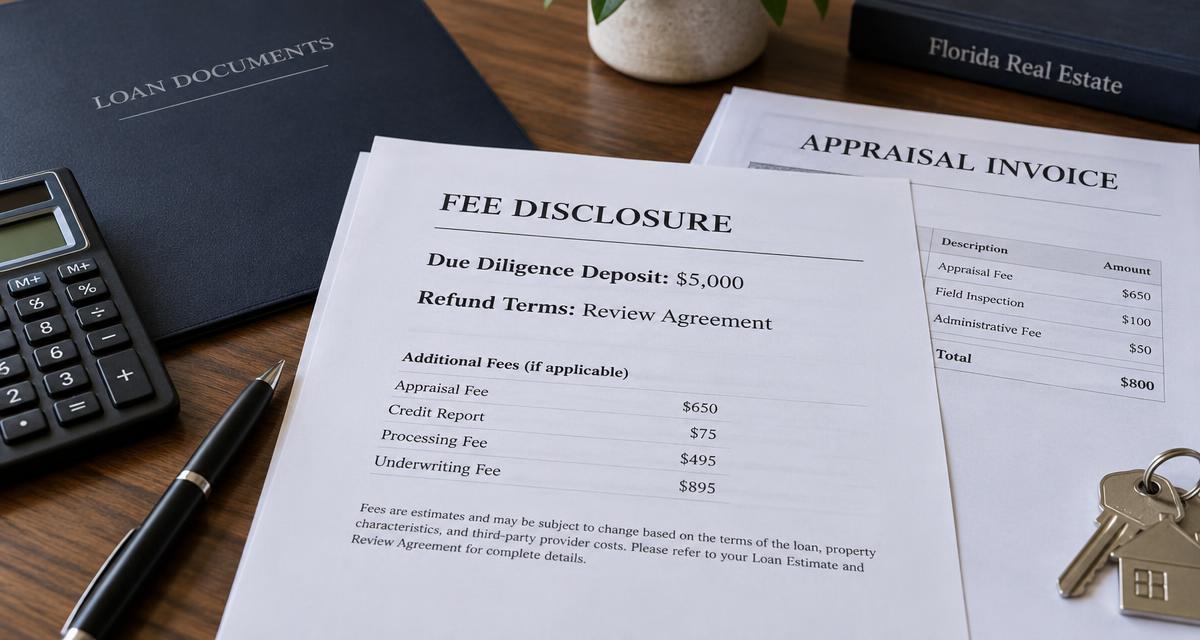
Investor Education
Upfront Due Diligence Deposits: How Florida Borrowers Can Avoid Costly Financing Mistakes
Know who receives your money, what work it covers and what happens if financing fails. A practical Florida guide to upfront deposits, written fee terms and independent verification.

Investor Education
How Unclear Payoff Statements and Property Liens Can Delay a Private Real Estate Loan Closing
An unclear payoff or an unresolved lien can stall a Florida private loan even when the property has equity. This guide explains payoff statements, lien types, combined loan to value on second mortgages, paying liens at closing and how to prevent delays.
Investor Education
Can You Borrow Against a Free-and-Clear Property in Florida?
A 2026 guide to unlocking equity in Florida real estate you own free and clear: first lien position, LTV sizing tables, worked residential, commercial, multifamily, and land examples, plus a private loan vs. cash-out refinance vs. HELOC comparison.

Investor Education
LTV vs. LTC vs. ARV: What's the Difference in Real Estate Lending?
LTV measures the loan against property value, LTC measures it against total project cost, and ARV estimates value once the work is done. Here is how Florida private lenders use all three, with one deal calculated three ways.

Investor Education
First-Lien vs. Second-Lien Loans: What Real Estate Investors Need to Know
A first lien holds the senior claim against a property while a second lien sits behind it. Here is how lien priority works, how LTV and CLTV differ, why equity drives second position financing, and how Florida records and ranks liens.