Investor Education
Term Sheet vs. Loan Commitment: What Has Actually Been Approved?
Published By Luminary Private Lending
- Author:
- Ivan Padilla
- Reviewed By:
- Kevin Mazzola
- Published:
- November 13, 2026

A term sheet lists proposed financing terms. A loan commitment generally states a lender's agreement to lend, subject to its conditions. Neither title alone confirms that underwriting is complete or funds are ready.
Quick Answer
A term sheet lists proposed financing terms. A loan commitment generally states a lender's agreement to lend, subject to the document's terms and conditions. Neither title alone confirms that underwriting is complete or that funds are ready. Funding happens only after the remaining conditions are satisfied.
For real estate investors, the practical questions are: What has the lender approved? What is still pending? What must happen before funding? This guide focuses on U.S. business purpose real estate financing, especially in Florida.
Term Sheet vs. Loan Commitment at a Glance
| Question | Term sheet | Loan commitment |
|---|---|---|
| What does it usually communicate? | Proposed loan structure and economics | Agreement to lend under stated terms |
| Is underwriting complete? | Do not assume it is | Read the letter; some approvals may remain |
| Is the lender obligated to fund? | Often expressly disclaimed | Depends on the agreement and its conditions |
| Can the borrower have obligations? | Yes; fees, expenses, confidentiality or exclusivity may apply | Yes; acceptance, fees and deadlines may apply, depending on the document |
| Are proceeds available immediately? | The document does not establish that | A commitment alone does not establish that |
| What should the borrower request? | Written clarification of approval status | A written list of remaining funding conditions |
These distinctions are practical, not universal definitions. Lenders may use different names.
What Is a Term Sheet?
A real estate loan term sheet summarizes the financing a lender is considering. It may cover:
- Proposed loan amount and interest rate
- Loan term, extension options and repayment structure
- Origination fees and third party expenses
- Loan to value (LTV) or loan to cost (LTC) limits
- Guaranties, reserves and renovation holdbacks
- Required underwriting, diligence and closing conditions
A detailed term sheet can still be preliminary. As one transaction example, a real estate financing term sheet filed as an exhibit with the SEC states that it is not a commitment to lend and lists conditions such as valuation, environmental review, title, survey and definitive documentation. Check both the quoted loan amount and the document's approval language.
Does signing a term sheet mean the lender has approved the loan?
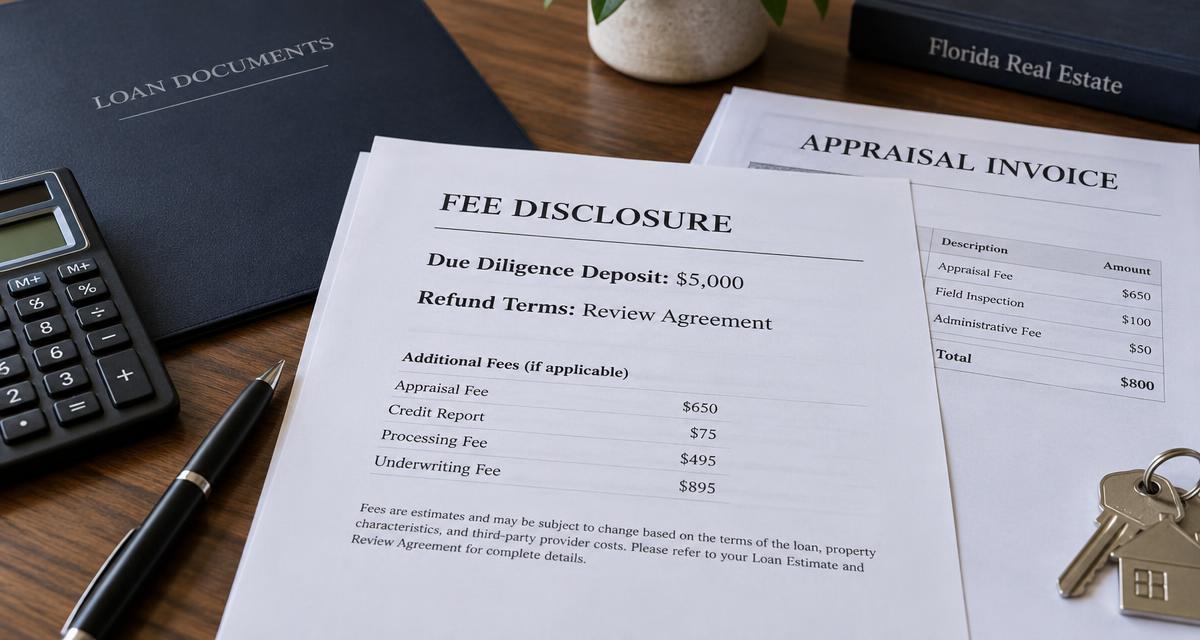
Signing a term sheet does not guarantee final loan approval. Understand what you agree to by signing and which provisions are binding. A borrower might agree to cover due diligence costs while the lender can still decline. Before signing, identify which provisions create obligations, whether any deposit is refundable and when, whether credit approval is still pending, whether the lender can change or withdraw the proposal, and when the proposal expires. Related: upfront due diligence deposits.
What Is a Loan Commitment?
A loan commitment generally states a lender's agreement to provide financing under specified terms, subject to its conditions. Its scope depends on the actual document. Before funding, a commitment may require:
- Title meeting the lender's requirements
- Insurance acceptable to the lender
- Executed loan documents acceptable to the lender
- Required borrower equity
- Other stated conditions
It may also include expiration dates or material change provisions. The OCC's Commercial Real Estate Lending handbook, which is bank supervisory guidance, notes that approval contingencies matter in commitment letters. It is useful context, not a rule for every private lender.
Does a commitment guarantee the money?
A commitment is not a disbursement. A commitment that needs only closing items differs from one that still needs discretionary credit approval. Ask the lender to state in writing which kind you hold.
How Loan Approval Stages Usually Work
- Proposed terms (term sheet)
- Underwriting review
- Conditional approval or commitment
- Closing requirements
- Disbursement
Lenders may use different names or sequences. What matters is knowing which stage your loan is actually in.
What Has Actually Been Approved? Three Hypothetical Examples
These examples are illustrations of how document review works. They are not Luminary loan offers, and each assumption, including the 75% LTV, belongs only to that example.
Example 1: Valuation reduces the supported loan amount
A lender proposes $300,000 to an investor for a fix and flip, based on a maximum 75% LTV and an acceptable as is valuation. The lender accepts a valuation of $360,000.
Calculation: $360,000 × 75% = $270,000.
What has been approved? Only proposed financing parameters. The original $300,000 depended on valuation, and the valuation supports $270,000 under that limit. Other requirements could reduce it further. See when an appraisal comes in low.
Example 2: An unresolved lien delays funding
An investor receives a $750,000 bridge loan commitment requiring acceptable first lien title coverage. Title review finds an existing lien that must be resolved.
What has been approved? A commitment under its terms. The title condition remains unresolved, so the borrower should confirm the required cure in writing. See liens and payoff statements and title issues.
Example 3: Construction funds release in stages
A construction commitment states a maximum loan amount of $1,200,000. The funding schedule provides $700,000 at closing and reserves $500,000 for future construction draws.
What has been approved? A maximum facility amount with separate disbursement conditions. The full $1,200,000 is not available at closing. Factor in fees, reserves, payoffs and required equity to calculate cash needed to close. See construction draw schedules.
Seven Questions to Ask Before Relying on an Approval
Borrower checklist: 7 questions before relying on an approval
- Who issued this document? Identify the funding lender and confirm the sender has authority to approve.
- Is credit approval complete? Request a clear description of any outstanding underwriting decisions.
- Which conditions remain? Ask for a dated written list instead of a general statement.
- What could change the loan amount or pricing? Review valuation assumptions, leverage limits, rate lock terms and adjustment provisions.
- How much will be disbursed at closing? Separate the maximum commitment from holdbacks, reserves, payoffs and net proceeds.
- When does the commitment expire? Confirm acceptance deadlines, closing timelines and extension requirements.
- What fees remain if the loan does not close? Review refund provisions and responsibility for incurred expenses.
Suggested written request:
“Please confirm the current approval stage, any remaining underwriting and funding conditions, the commitment expiration date, and the expected disbursement amount at closing.”
Print this checklist or save it as a PDF from your browser and bring it to your next lender conversation.
A Florida Consideration: Written Terms Matter
Florida Statutes §687.0304 requires a written agreement expressing consideration, stating relevant terms and conditions, and signed by creditor and debtor for a debtor to maintain an action on that agreement. This does not mean every signed term sheet is an enforceable promise to fund; the document's substance and applicable law require careful analysis. Have your transaction attorney review disputed commitment language and any financing contingency before relying on a document to meet a purchase contract deadline.
Is a Loan Estimate the Same as a Term Sheet or Commitment?
No. A consumer mortgage Loan Estimate is a separate disclosure. The CFPB explains that receiving one does not mean the lender has approved or denied the application. Consumer disclosures do not apply universally, and business purpose investment loans may involve different disclosures. Confirm which requirements apply to your transaction.
Frequently Asked Questions
Can a lender decline a loan after issuing a term sheet?
A lender may decline a loan after issuing a term sheet if the proposed financing still needs credit approval or other stated requirements remain unmet. The term sheet's own wording controls.
Can a loan go unfunded after a commitment?
A loan may fail to fund after a commitment if applicable funding conditions remain unsatisfied, the commitment expires, or another contract provision applies. Whether a lender can lawfully refuse to fund depends on the agreement and applicable law.
Is a signed term sheet legally binding?
A signed term sheet can contain binding provisions, such as fee, expense, confidentiality or exclusivity terms, even when the proposed loan itself is expressly nonbinding. A signature alone does not establish a lender's obligation to fund.
Does paying a deposit guarantee loan approval?
Paying a deposit does not by itself guarantee loan approval. Check what the payment covers, whether and when it is refundable, and which approval conditions still apply.
What is the clearest evidence of my current loan status?
The clearest evidence is a dated written confirmation from the authorized lender stating the approval stage, the remaining conditions, the relevant deadlines and the expected disbursement amount at closing.
Sources, Author and Review
- Florida Statutes §687.0304: written credit agreement requirements for a debtor's action.
- OCC Comptroller's Handbook, Commercial Real Estate Lending: bank supervisory context on commitments.
- CFPB, Loan Estimate explainer: consumer disclosure, not approval.
- SEC EDGAR: one filed term sheet exhibit used as a transaction example, not a rule.
Author: Ivan Padilla, Director of Growth and Real Estate Lending Specialist, part of the team at Luminary Private Lending. Reviewed by: Kevin Mazzola, Founder of Luminary Private Lending. This article has not been reviewed by an attorney. Sources last reviewed: November 13, 2026.
Know Your Approval Stage Before Planning Your Closing
A proposed loan amount, a conditional commitment and funded proceeds are different milestones. Review the document, identify any decisions left, and confirm the conditions for disbursement. Explore Luminary Private Lending's real estate financing programs, contact us, call (321) 621-1280 or get started. Related: personal guarantees on LLC loans.
Educational information only. This article is not a loan offer, commitment to lend or legal advice. Loan availability and terms depend on transaction specific review and applicable requirements.
Related Florida Lending Resources
Keep Reading
Latest Insights
Keep exploring Florida private lending insights.

Investor Education
Transactional Funding for Florida Wholesalers: How Double Closings Work
Transactional funding provides short-term purchase capital for wholesalers completing a double closing. Here is how the A-to-B and B-to-C closings work, a hypothetical example, and what to prepare.

Investor Education
What Does a Personal Guarantee Mean on an LLC Real Estate Loan in Florida?
A personal guarantee is an individual's agreement to cover specified obligations of an LLC borrower. Owning a Florida LLC does not alone make you liable for its debts, but signing a guarantee can. The signed terms set the scope.

Investor Education
What Does 125% Lender’s Title Insurance Mean? Florida Private Lending Guide
A 125% lender’s title insurance requirement means the policy amount equals 125% of the loan principal. It does not mean the borrower receives 25% more money or pays a 25% fee. On a $1,950,000 loan, 125% coverage equals $2,437,500; actual protection depends on the policy terms.
Investor Education
Upfront Due Diligence Deposits: How Florida Borrowers Can Avoid Costly Financing Mistakes
Know who receives your money, what work it covers and what happens if financing fails. A practical Florida guide to upfront deposits, written fee terms and independent verification.

Investor Education
Purchase Price Higher Than the Listing? Here’s What Could Really Be Going On
A higher contract price can be legitimate, but a material unexplained difference deserves independent verification. This guide explains how lenders can reconcile the listing, contract, appraisal, title and closing figures.

Investor Education
How Unclear Payoff Statements and Property Liens Can Delay a Private Real Estate Loan Closing
An unclear payoff or an unresolved lien can stall a Florida private loan even when the property has equity. This guide explains payoff statements, lien types, combined loan to value on second mortgages, paying liens at closing and how to prevent delays.

Investor Education
Can You Get a Private Real Estate Loan Without Tax Returns in Florida?
Tax returns do not always reflect an investor's real financial strength. This Florida guide explains how asset-based private lenders evaluate property value, equity, loan-to-value, liquidity, use of funds and exit strategy instead of conventional income documentation.

Investor Education
Can a Newly Formed LLC Qualify for a Private Real Estate Loan in Florida?
A newly formed LLC may still qualify for private real estate financing in Florida. This guide explains what asset-based lenders review instead of operating history: property value, equity, liens, liquidity, the principals, documentation and the exit strategy.

Investor Education
Title Issues & Code Violations: Can They Get a Private Real Estate Loan Denied in Florida?
Strong equity and a supportive appraisal do not guarantee a closing. This Florida guide explains how title defects, recorded liens, municipal code liens, open permits and unpermitted work affect private lending, which issues are usually curable, what documentation to send up front, and why lien position matters as much as value.

Investor Education
Can an LLC Get a Real Estate Loan Without Personal Credit? A Florida Private Lending Guide
An LLC real estate loan without personal credit as the deciding factor is possible with asset-based private lenders. This Florida guide covers what lenders review instead, LTV math with worked scenarios, new-LLC and free-and-clear situations, the difference between a credit pull and a personal guarantee, and a borrower document checklist.

Investor Education
What Happens If a Property Appraises Lower Than Expected?
A low appraisal changes the numbers, not always the deal. How a lower-than-expected value affects LTV, loan proceeds, the appraisal gap, construction and refinance requests, and what Florida investors can do next.
Investor Education
Can You Borrow Against a Free-and-Clear Property in Florida?
A 2026 guide to unlocking equity in Florida real estate you own free and clear: first lien position, LTV sizing tables, worked residential, commercial, multifamily, and land examples, plus a private loan vs. cash-out refinance vs. HELOC comparison.