Investor Education
What Is Cross Collateralization in Private Lending? A Complete Guide for Real Estate Investors
Published By Luminary Private Lending
- Author:
- Ivan Padilla
- Reviewed By:
- Kevin Mazzola
- Published:
- August 7, 2026

Cross collateralization lets investors combine equity from several properties to secure one loan. Here is how the collateral package works, who it fits, the risks, lender requirements, and a Florida example that closed in ten days.
Cross collateralization is a financing strategy in which two or more properties secure a single loan. In private lending, it allows borrowers to combine equity from multiple assets, often increasing borrowing power while reducing the lender's risk.
Table of Contents
- What Does Cross Collateralization Mean?
- How It Works Step by Step
- The Structure at a Glance
- Why Private Lenders Use It
- Benefits for Real Estate Investors
- Real World Example
- Case Study: A Florida Investor Closing in Ten Days
- Common Scenarios
- Who Should Consider It?
- Who Should Avoid It?
- Pros and Cons
- Potential Risks
- How Long Does It Take?
- Lender Requirements
- Comparison Chart
- Cross Collateralization vs. Blanket Loans
- Can It Help Borrowers With Credit Challenges?
- Seven Common Mistakes
- Myth vs. Fact
- Related Terms
- Frequently Asked Questions
- People Also Ask
Real estate investors aim to build equity, keep steady cash flow, and stay flexible for the next opportunity. One structure that supports all three is cross collateralization.
Though the word sounds complex, the idea is simple. In private lending, a borrower can pledge several properties as security for one loan. The lender underwrites the total value of the collateral package instead of the equity position in a single property. That broader view of loan security often helps a borrower qualify for a larger amount or better terms on property backed financing.
Experienced investors, developers, and business owners use this approach for acquisitions, construction, bridge financing, and business expansion, because it delivers capital quickly without forcing a sale.
What Does Cross Collateralization Mean?
Cross collateralization secures one loan with more than one property or asset. Instead of relying on a single mortgage lien, the borrower pledges two or more properties, which gives the lender additional security while the borrower reaches more capital.
Consider a simple pledged assets example:
| Property | Value | Existing Mortgage | Available Equity |
|---|---|---|---|
| Property A | $700,000 | $250,000 | $450,000 |
| Property B | $500,000 | $100,000 | $400,000 |
| Combined | $1,200,000 | $350,000 | $850,000 |
The lender evaluates the collateral package rather than each property in isolation. This is standard practice in asset based lending, where collateral strength and the borrower's repayment plan carry the most weight.
How It Works Step by Step
Step 1. Review the Properties
The lender examines each asset offered as security: property type, market value, condition, existing liens, location, and ownership structure.
Step 2. Calculate Available Equity
Next the lender determines usable equity after existing debt.
| Property | Value | Mortgage | Equity |
|---|---|---|---|
| Property One | $600,000 | $250,000 | $350,000 |
| Property Two | $800,000 | $300,000 | $500,000 |
| Combined Equity | $850,000 | ||
Step 3. Determine the Loan Amount
Private lenders apply a maximum loan to value ratio against the combined collateral. The measure of protection is the entire package, not one address.
Step 4. Secure the Loan
The loan is recorded against each property named in the agreement. When the borrower satisfies the terms, the liens release at payoff.
The Structure at a Glance
            ONE LOAN
               |
   +-----------+-----------+
   |           |           |
Property A  Property B  Property C
   |           |           |
   +-----------+-----------+
               |
       COMBINED EQUITY
               |
        PRIVATE LENDER
               |
        LOAN APPROVED
Why Private Lenders Use It
Private lenders underwrite collateral first. Adding assets to the security package lowers exposure, which is why this financing structure appears so often in commercial lending.
- Greater collateral coverage
- Improved loan security
- Increased repayment confidence
- Flexibility for unusual or time sensitive deals
- Capacity to finance larger projects
You will see it most in bridge loans, commercial financing, construction lending, and portfolio refinancing. If you are weighing short term options, our guide on bridge loans in Florida explains how the timing and payoff work.
Benefits for Real Estate Investors
Access More Capital
The most obvious advantage is borrowing power. Backing one loan with several assets means the deal is not capped by the equity in a single property. That capital funds acquisitions, construction, renovations, business expansion, payoff of higher cost debt, and purchases that cannot wait.
Keep Existing Investments
Selling a property to raise cash can create a tax event, remove rental income, and give up future appreciation. A cross collateralized loan unlocks equity while the real estate portfolio stays intact. The IRS publishes guidance on the tax treatment of real property dispositions, and any decision to sell should be reviewed with your tax advisor.
Finance Larger Opportunities
Larger projects need larger capital. Combining properties can qualify a borrower for financing that a single asset would not support: apartment complexes, office buildings, industrial property, retail centers, land development, and multi property acquisitions.
Simplify Financing
Rather than stacking separate notes, borrowers consolidate into one transaction with one payment, one maturity date, and far less administration.
"Cross collateralization can be one of the most effective tools for experienced investors when structured responsibly." — Ivan Padilla, Luminary Private Lending
Private credit and non bank lending have expanded meaningfully over the past decade, and regulators including the FDIC track commercial real estate lending volume each quarter. The SBA similarly recognizes multiple asset collateral in its business lending programs, which shows how common the practice is beyond private lending alone.
Real World Example
Imagine an investor who owns three properties.
| Asset | Value | Mortgage Balance | Equity |
|---|---|---|---|
| Rental home | $450,000 | $150,000 | $300,000 |
| Vacant land | $500,000 | None | $500,000 |
| Commercial warehouse | $950,000 | $350,000 | $600,000 |
| Total available equity | $1.4 million | ||
The investor needs a bridge loan to buy another commercial building before refinancing. Instead of leaning on one address, the lender underwrites the combined collateral. A conservative loan to value across the package opens financing that no single property could carry.
Case Study: A Florida Investor Closing in Ten Days
An investor in Central Florida owned three rentals near Orlando, Kissimmee, and Lakeland, with roughly $520,000 of combined equity and modest first liens on two of them. A fourth property came to market at a discount with a short closing window. A bank refinance on any single rental would not have produced enough proceeds in time.
By pledging all three rentals as one collateral package, the borrower secured $400,000 in secured financing at a conservative combined loan to value, funded the acquisition, and closed in ten days. Twelve months later the new property was stabilized, refinanced onto long term debt, and the liens on the original rentals released at payoff.
Common Scenarios
- Buying apartment complexes
- Fix and flip projects
- Ground up construction, covered further in our construction financing guide
- Land acquisition and vacant land financing
- Commercial refinance
- Business cash flow needs
- Cash out against equity across a portfolio, sometimes alongside a second mortgage
Who Should Consider It?
This structure fits borrowers who already hold real estate and want to use it efficiently. It suits investors adding to a portfolio, developers funding a build, LLC owners borrowing through an entity, commercial borrowers financing larger assets, and portfolio owners consolidating several notes into one.
Who Should Avoid It?
Cross collateralization may not be ideal if:
- You plan to sell one of the properties soon.
- You have little available equity across your assets.
- You want to refinance each property independently later.
- You want maximum flexibility to move assets in and out of financing.
Pros and Cons
| Pros | Cons |
|---|---|
| Larger loan amounts | More assets at risk |
| Faster approvals | More paperwork and due diligence |
| Better leverage on existing equity | Refinancing individual assets is harder |
| One payment and one maturity date | Selling a property usually needs lender consent |
| Assets stay in the portfolio | Additional appraisal and title cost |
Potential Risks
Many Properties Secure One Loan
If the borrower defaults, every pledged asset could be affected. This is the single most important consideration before signing.
Selling a Property May Need Approval
Because collateral is shared, releasing one address usually requires lender consent, a partial payoff, or a loan modification.
Refinancing Can Be More Complex
Replacing the note means coordinating the release of liens across every property in the package.
More Documentation
Multi property transactions require additional appraisals, title work, insurance, and legal documentation. Borrowers should read every term carefully, and the Consumer Financial Protection Bureau publishes useful background on reviewing loan documents before closing.
How Long Does It Take?
| Stage | Typical Timing |
|---|---|
| Application and collateral summary | Day 1 |
| Property review and valuations | Day 2 to 5 |
| Title and lien search on each asset | Day 5 to 8 |
| Underwriting and approval | Day 8 to 12 |
| Closing and recording | Day 10 to 14 |
Lender Requirements
Most private lenders review the following on every pledged asset:
- Available equity and combined loan to value
- Appraisal or valuation
- Clear title
- Property and liability insurance
- A documented exit strategy
- Ownership and entity documents
- Existing liens and payoff figures
Comparison Chart
| Cross Collateral | HELOC | Cash Out Refinance | Bridge Loan | |
|---|---|---|---|---|
| Properties secured | Two or more | One | One | One or more |
| Typical speed | Days to weeks | Weeks | Weeks to months | Days to weeks |
| Best for | Portfolio owners | Small draws | Long term debt | Timing gaps |
| Existing debt | Can stay in place | Stays in place | Replaced | Can stay in place |
| Investment property | Common | Limited | Case by case | Common |
Cross Collateralization vs. Blanket Loans
| Cross Collateralization | Blanket Loan |
|---|---|
| Many properties secure one obligation | Designed to finance several properties with one loan |
| Often uses assets the borrower already owns | Commonly used to buy or refinance a portfolio |
| Focus is combining collateral | Usually includes partial release provisions so individual assets can be sold |
Both structures involve multiple properties, but the legal documents and release terms differ.
Can It Help Borrowers With Credit Challenges?
Many private lenders weigh collateral strength ahead of a credit score. Credit history may still be reviewed, but the emphasis usually falls on property value, available equity, the loan to value ratio, the exit strategy, investment experience, and the overall strength of the transaction. That asset based approach creates options that a traditional bank often cannot offer, particularly for seasoned investors with a meaningful equity position.
Seven Common Mistakes
- Pledging more property than the deal actually requires.
- Overlooking the partial release language in the note.
- Assuming any single property can be sold without lender consent.
- Underestimating combined appraisal, title, and legal cost.
- Ignoring how existing liens reduce usable equity.
- Borrowing without a documented repayment plan.
- Failing to insure each pledged asset correctly.
Myth vs. Fact
| Myth | Fact |
|---|---|
| Only commercial investors use it. | Residential investors use it frequently on rentals and small portfolios. |
| You must own the properties free and clear. | Existing mortgages are common. The lender underwrites the remaining equity. |
| You can never sell a pledged property. | You usually can with lender consent, a partial payoff, or a release provision. |
| It always costs more. | Pricing depends on combined loan to value, asset quality, and the exit. |
Related Terms
Investors often confuse these ideas: blanket loans, portfolio loans, bridge loans, cash out refinance, cross default, and cross pledge. Each affects loan security and release rights differently, so ask which applies to your note.
People Also Ask
Can you use two properties as collateral for one loan?
Yes. Many private lenders allow borrowers to use two or more investment properties as collateral for one loan if sufficient equity exists and the transaction meets underwriting requirements.
Is cross collateralization good?
Cross collateralization can be beneficial for investors who own multiple properties because it may increase borrowing power, simplify financing, and provide access to larger loan amounts. Borrowers should understand that multiple properties secure the same debt.
Is cross collateralization risky?
The primary risk is that if the borrower defaults, every property pledged as collateral could be affected. Investors should review loan terms carefully and hold a clear repayment strategy.
Can commercial and residential properties be combined?
In many cases, yes. Some private lenders allow residential, commercial, mixed use, or vacant land properties to be combined as collateral, provided the overall transaction meets underwriting guidelines.
Final Thoughts
Choosing the right financing structure depends on your equity, investment goals, timeline, and exit strategy. Understanding how cross collateralization works allows investors to make more informed borrowing decisions and determine whether leveraging multiple properties is the right solution for the next opportunity.
At Luminary Private Lending we review each transaction individually and work with borrowers to structure financing around property value, available equity, and a clear repayment plan. Whether you are buying an investment property, expanding a portfolio, funding construction, or bridging a timing gap, our team can help you weigh the options.
Related Reading
- What Is a Bridge Loan in Florida?
- What Is a Balloon Payment?
- Second Mortgages in Florida
- Florida Private Lending by County
Author and Reviewer
Author. Ivan Padilla, Director of Growth and Real Estate Lending Specialist, Luminary Private Lending. Ivan works daily with Florida investors and builders on bridge, construction, second mortgage, and vacant land financing.
Reviewed by. Kevin Mazzola, Founder of Luminary Private Lending. Kevin has structured asset based financing for investors and entities throughout Florida.
Published: August 7, 2026. Last updated: August 2026. Last reviewed: August 7, 2026. Editorial and credit review by Luminary Private Lending. This article is educational and is not a lending commitment or an offer of credit.
Related Florida Lending Resources
Keep Reading
Latest Insights
Keep exploring Florida private lending insights.

Investor Education
Can an LLC Get a Real Estate Loan Without Personal Credit? A Florida Private Lending Guide
An LLC real estate loan without personal credit as the deciding factor is possible with asset-based private lenders. This Florida guide covers what lenders review instead, LTV math with worked scenarios, new-LLC and free-and-clear situations, the difference between a credit pull and a personal guarantee, and a borrower document checklist.

Investor Education
What Is a Balloon Payment? A Complete Guide for Real Estate Investors in Florida
A balloon payment is a large final payment due at the end of a short term loan. Here is how balloon loans work, which programs use them, real Florida examples, the risks, and how investors plan an exit strategy before borrowing.

Investor Education
What Does 125% Lender’s Title Insurance Mean? Florida Private Lending Guide
A 125% lender’s title insurance requirement means the policy amount equals 125% of the loan principal. It does not mean the borrower receives 25% more money or pays a 25% fee. On a $1,950,000 loan, 125% coverage equals $2,437,500; actual protection depends on the policy terms.

Investor Education
How Unclear Payoff Statements and Property Liens Can Delay a Private Real Estate Loan Closing
An unclear payoff or an unresolved lien can stall a Florida private loan even when the property has equity. This guide explains payoff statements, lien types, combined loan to value on second mortgages, paying liens at closing and how to prevent delays.

Investor Education
Can You Get a Private Real Estate Loan Without Tax Returns in Florida?
Tax returns do not always reflect an investor's real financial strength. This Florida guide explains how asset-based private lenders evaluate property value, equity, loan-to-value, liquidity, use of funds and exit strategy instead of conventional income documentation.

Investor Education
Can a Newly Formed LLC Qualify for a Private Real Estate Loan in Florida?
A newly formed LLC may still qualify for private real estate financing in Florida. This guide explains what asset-based lenders review instead of operating history: property value, equity, liens, liquidity, the principals, documentation and the exit strategy.

Investor Education
Title Issues & Code Violations: Can They Get a Private Real Estate Loan Denied in Florida?
Strong equity and a supportive appraisal do not guarantee a closing. This Florida guide explains how title defects, recorded liens, municipal code liens, open permits and unpermitted work affect private lending, which issues are usually curable, what documentation to send up front, and why lien position matters as much as value.

Investor Education
LTV vs. LTC vs. ARV: What's the Difference in Real Estate Lending?
LTV measures the loan against property value, LTC measures it against total project cost, and ARV estimates value once the work is done. Here is how Florida private lenders use all three, with one deal calculated three ways.

Investor Education
What Is an Interest Reserve in a Construction Loan? A Complete Guide for Builders and Contractors
An interest reserve covers construction loan interest from loan proceeds while the property produces no income. Here is how lenders size it, how it interacts with the draw schedule, and what happens when a build runs long.

Investor Education
First-Lien vs. Second-Lien Loans: What Real Estate Investors Need to Know
A first lien holds the senior claim against a property while a second lien sits behind it. Here is how lien priority works, how LTV and CLTV differ, why equity drives second position financing, and how Florida records and ranks liens.

Investor Education
What Do Private Lenders Look for in an Appraisal?
A private lender reads an appraisal for value, comparable sales, condition, marketability, zoning, and projected value at completion. Here are the 12 things Florida borrowers should know, with worked LTV, CLTV, and LTC examples.
Investor Education
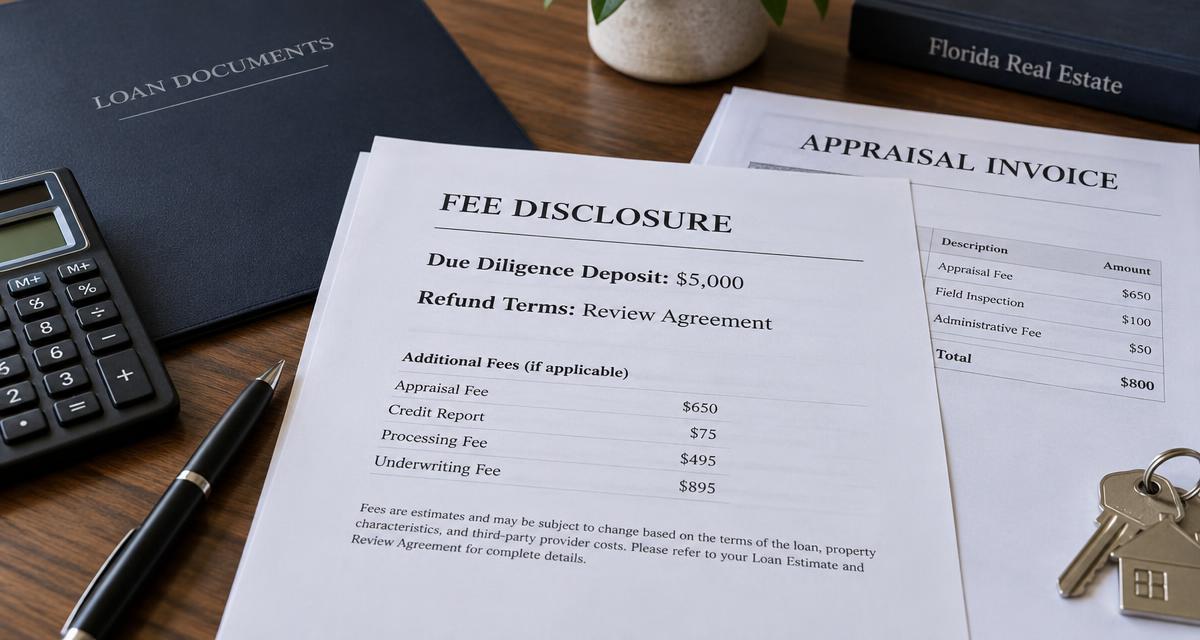
Upfront Due Diligence Deposits: How Florida Borrowers Can Avoid Costly Financing Mistakes
Know who receives your money, what work it covers and what happens if financing fails. A practical Florida guide to upfront deposits, written fee terms and independent verification.