Construction Financing
Dutch vs. Non-Dutch Interest on Construction Loans: What Borrowers Need to Know
Published By Luminary Private Lending
- Author:
- Ivan Padilla
- Reviewed By:
- Kevin Mazzola
- Published:
- September 7, 2026

Dutch interest is calculated on the full construction loan commitment. Non-Dutch interest is calculated on funds actually advanced. Worked $2 million examples, a full 12-month draw table, a Naples scenario and an interactive calculator show why a 12% loan can cost less than a 10% loan.
When comparing construction loan offers, most borrowers look first at the interest rate. Is the loan 10%? 12%? 14%? The stated rate does not always show which construction loan is cheaper. The question that often matters more is what balance the lender uses to calculate interest during construction.
Quick Answer: Dutch vs. Non-Dutch Interest
Dutch interest generally describes a construction loan where interest is calculated on the full committed loan amount, including funds that have not been disbursed yet. Non-Dutch interest generally describes interest calculated only on the amounts actually advanced and outstanding. Terminology varies by lender, so borrowers should confirm the calculation method in the loan documents.
Definition Box
Dutch interest = interest calculated on the full committed loan amount.
Non-Dutch interest = interest calculated on the amounts actually advanced and outstanding, depending on the loan documents.
Ask your lender directly: "What balance will my interest be based on before the full construction loan is disbursed?"
Key Takeaway
A lower interest rate does not necessarily mean a lower total interest cost. A 12% loan that charges interest only on funds advanced can cost less than a 10% loan that charges interest on the entire commitment.

What This Guide Covers
- What Dutch interest is on a construction loan
- What non-Dutch interest is
- The $2 million side-by-side example
- Why 10% can cost more than 12%
- Dutch vs. non-Dutch comparison table
- How construction draws affect interest
- A full 12-month draw and interest table
- Interactive Dutch vs. non-Dutch calculator
- Interest reserves and how they differ
- Is Dutch interest legal in Florida?
- Naples luxury construction example
- What Florida builders should review
- 10 questions to ask before accepting a construction loan
- Frequently asked questions
Why Construction Loan Interest Works Differently
Construction financing differs from a traditional mortgage. You do not receive the whole budget at closing. Construction funds are usually released through a draw schedule as the project progresses. A simplified schedule can include:
- Site preparation and foundation
- Framing and roofing
- Plumbing, electrical and HVAC
- Drywall and interior construction
- Cabinets, flooring and finishes
- Final completion
The lender typically inspects or verifies completed work before funding the next draw. As additional draws fund, the outstanding balance increases. That makes one question critical: does interest accrue on the amount advanced, or on the full loan commitment?
What Is Dutch Interest on a Construction Loan?
In private construction lending, "Dutch interest" generally means interest is calculated on the full committed loan amount, even where portions of that loan have not been disbursed.
Consider a simplified example. A developer is approved for a $2,000,000 construction loan at a 10% annual rate, and only $500,000 has been advanced.
$2,000,000 × 10% ÷ 12 = approximately $16,667 per month
The calculation relies on the committed balance, not the $500,000 advanced. Loan documents may calculate interest in different ways, so review the note and loan agreement rather than relying on industry shorthand.
What Is Non-Dutch Interest?
"Non-Dutch interest" generally means interest is calculated on the amount actually advanced and outstanding. Using the same numbers:
$500,000 × 10% ÷ 12 = approximately $4,167 per month
When another construction draw funds, the outstanding balance rises and interest is calculated on the new balance under the loan terms. Interest expense therefore increases progressively as construction moves toward completion.
Dutch vs. Non-Dutch Interest: $2 Million Side-by-Side Example
Assume a Florida builder receives a $2 million construction loan. For illustration, both structures carry a 10% annual rate and a 12-month construction period, with $500,000 advanced at closing.
| Item | Dutch-Style | Non-Dutch |
|---|---|---|
| Total loan commitment | $2,000,000 | $2,000,000 |
| Amount initially advanced | $500,000 | $500,000 |
| Example interest rate | 10% | 10% |
| Illustrative calculation base | $2,000,000 | $500,000 and rising |
| Approximate first-month interest | $16,667 | $4,167 |
| Total estimated interest over 12 months | $200,000 | approximately $125,000 |
The early-stage monthly difference is roughly $12,500, and the illustrative 12-month difference is roughly $75,000 where draws fund evenly. This does not mean every non-Dutch loan is automatically cheaper. Rates, origination points, draw fees, minimum interest requirements, inspection fees, interest reserves, extension fees and how quickly funds are advanced all affect total financing cost.
Why a Lower Interest Rate Does Not Always Mean a Cheaper Construction Loan
Imagine a builder receives two offers.
- Loan A. 10% interest, calculated on the entire commitment.
- Loan B. 12% interest, calculated only on funds advanced and outstanding.
Loan A appears cheaper because 10% is lower than 12%. But if both lenders commit $2 million and the project's average outstanding balance for the year is $1 million:
| Offer | Rate | Interest basis | Total estimated annual interest |
|---|---|---|---|
| Loan A (Dutch) | 10% | $2,000,000 commitment | $200,000 |
| Loan B (non-Dutch) | 12% | $1,000,000 average balance | $120,000 |
Loan B carries the higher stated rate and produces roughly $80,000 less interest in this illustration. Sophisticated borrowers compare the interest calculation method and the projected draw schedule, not just the headline rate.
Dutch vs. Non-Dutch: Feature Comparison
| Feature | Dutch interest | Non-Dutch interest |
|---|---|---|
| Interest basis | Full committed loan amount | Amounts advanced and outstanding |
| Undrawn funds | Generally included in the calculation | Generally excluded until advanced |
| Effect of each draw | Little or no change to monthly interest | Monthly interest rises with each draw |
| Early-stage carrying cost | Higher | Lower |
| Payment predictability | More predictable, level payments | Variable, rises with construction progress |
| What to verify | Calculation base, accrual start date, minimum interest | Accrual start date, day-count method, draw timing and fees |
How Construction Draws Affect Non-Dutch Interest
With an outstanding-balance structure, the timing of construction draws directly affects interest expense. Consider a simplified $2 million project at 12%:
| Construction stage | Cumulative amount advanced | Approximate monthly interest |
|---|---|---|
| Initial draw | $400,000 | $4,000 |
| Second draw | $750,000 | $7,500 |
| Third draw | $1,100,000 | $11,000 |
| Fourth draw | $1,500,000 | $15,000 |
| Fifth draw | $1,800,000 | $18,000 |
| Fully advanced | $2,000,000 | $20,000 |
This is why construction and financing schedules should be reviewed together. Delays, early draws, resequenced work and extensions all move carrying costs.
A Full 12-Month Draw and Interest Example
The table below models a $2,000,000 commitment over a 12-month build. The Dutch column uses 10% on the full commitment. The non-Dutch column uses 12% on the outstanding principal.
| Month | Cumulative draws | Outstanding principal | Non-Dutch interest at 12% | Dutch interest at 10% |
|---|---|---|---|---|
| 1 | $400,000 | $400,000 | $4,000 | $16,667 |
| 2 | $550,000 | $550,000 | $5,500 | $16,667 |
| 3 | $750,000 | $750,000 | $7,500 | $16,667 |
| 4 | $900,000 | $900,000 | $9,000 | $16,667 |
| 5 | $1,100,000 | $1,100,000 | $11,000 | $16,667 |
| 6 | $1,250,000 | $1,250,000 | $12,500 | $16,667 |
| 7 | $1,400,000 | $1,400,000 | $14,000 | $16,667 |
| 8 | $1,550,000 | $1,550,000 | $15,500 | $16,667 |
| 9 | $1,700,000 | $1,700,000 | $17,000 | $16,667 |
| 10 | $1,850,000 | $1,850,000 | $18,500 | $16,667 |
| 11 | $1,950,000 | $1,950,000 | $19,500 | $16,667 |
| 12 | $2,000,000 | $2,000,000 | $20,000 | $16,667 |
| Total estimated interest | — | — | $154,000 | $200,000 |
In this illustration the 12% outstanding-balance loan produces roughly $46,000 less total interest than the 10% full-commitment loan, even though its stated rate is two points higher. Change the draw pace and the answer changes with it.
How Do You Calculate Interest on a Construction Loan?
A simplified interest-only calculation is:
Outstanding Principal × Annual Interest Rate ÷ 12 = Approximate Monthly Interest
For example, $750,000 × 12% ÷ 12 = approximately $7,500 per month. Real loan calculations may use daily accrual and specific day-count conventions such as actual/360, so the actual amount can differ from a simple monthly estimate. Ask the lender for its exact calculation method when evaluating an offer.
Interactive Dutch vs. Non-Dutch Calculator
Use the estimator below to compare illustrative interest costs for your own commitment, rates and construction timeline.
Dutch Interest vs. Interest Reserve
An interest reserve is money set aside within a construction loan to fund interest payments during the build, so the borrower does not need outside cash flow for every payment. It should not be confused with non-Dutch interest. The two answer different questions:
- Interest calculation method. What balance is used to calculate interest?
- Interest reserve. Where does the money used to make the interest payment come from?
A construction loan can have an interest reserve and its own calculation base. An interest reserve does not eliminate interest cost. Depending on structure, reserve advances may increase the loan balance. Borrowers should confirm whether the reserve is part of the total commitment, how reserve advances change the balance, and what happens if the reserve is exhausted before completion.
Is Dutch Interest the Same as an Undrawn Commitment Fee?
Not automatically. An undrawn commitment fee is typically a separate fee charged on the unused portion of a facility, often stated as a percentage per year on undrawn funds. A full-commitment interest structure instead calculates contractual interest on the whole commitment. Some loans have neither, one, or both. Read the note, the loan agreement and the fee schedule together rather than treating the concepts as interchangeable.
Dutch Interest vs. Construction Draws
These are two separate mechanics. The draw schedule controls when money is released, usually tied to inspected completion stages or approved costs. The loan agreement controls how interest is calculated. A conservative draw schedule does not by itself reduce interest if the note calculates interest on the full commitment.
Do All Construction Loans Charge Interest Only on Drawn Funds?
No. Structures vary by lender and program. Some calculate interest on amounts actually advanced, and some calculate interest on the total commitment regardless of when advances occur. The distinction is not merely theoretical: federal construction-loan disclosure guidance in Appendix D to Regulation Z addresses both a loan on which interest is payable only on amounts actually advanced and a loan on which interest accrues on the full commitment (Consumer Financial Protection Bureau, Regulation Z Appendix D). Verify the calculation method in your own loan documents.
Is Dutch Interest Legal in Florida?
Florida law does not use the term "Dutch interest." Interest and usury are addressed generally in Chapter 687, Florida Statutes, which sets out rules on interest rates and unlawful charges, and business-purpose loans are treated differently from consumer credit. Whether a particular interest structure or effective rate complies depends on the loan documents, the loan purpose, the amount and the applicable law. This article is educational and is not legal advice. Borrowers and lenders should have specific loan structures reviewed by qualified Florida counsel.
Why Would a Lender Use a Full-Commitment Structure?
A construction lender reserves capital for a project before disbursing all of it. From the lender's perspective, committed capital must remain available as construction progresses. A full-commitment interest structure compensates the lender for holding that capital. What matters to the borrower is when interest begins accruing and which balance is used. Neither the stated rate nor the terminology alone answers that.
Why Builders May Prefer Non-Dutch Interest
For projects that draw construction funds over time, an outstanding-balance structure can lower early carrying costs. This is often relevant for:
- Ground-up construction
- Luxury spec homes
- Multifamily development
- Commercial construction
- Major renovation projects
- Longer construction timelines
- Large construction budgets
The larger the undrawn portion and the longer it stays undrawn, the more the calculation method matters. For a deeper comparison of project types, see ground-up construction versus heavy rehab financing.
What Happens to Interest After Each Construction Draw?
With an outstanding-balance structure, each funded draw raises principal, so future interest accrues on a higher amount. Before draw #3 the outstanding balance may be $700,000. After a $300,000 draw it is $1,000,000. At 12%, a simplified monthly calculation moves from approximately $7,000 to approximately $10,000. Construction loan payments can rise during the project even when the rate never changes.
Example: Naples Luxury Construction Project
Consider an investor developing a luxury spec home in Naples, Collier County, Florida. The borrower owns the lot with meaningful land equity and needs a $3,000,000 construction facility, but not all $3,000,000 on day one. Capital is needed progressively:
Site work → Foundation → Framing → Dry-in → Mechanical systems → Interior finishes → Completion
| Stage | Cumulative advanced | Non-Dutch monthly interest at 11% | Full-commitment monthly interest at 11% |
|---|---|---|---|
| Site work and foundation | $600,000 | $5,500 | $27,500 |
| Framing and dry-in | $1,400,000 | $12,833 | $27,500 |
| Mechanical systems | $2,100,000 | $19,250 | $27,500 |
| Interior finishes | $2,700,000 | $24,750 | $27,500 |
| Completion | $3,000,000 | $27,500 | $27,500 |
On a project this size, understanding that difference before closing can matter as much as negotiating the rate. Land equity may also affect how much the lender advances at closing, which changes the earliest interest figures. See land acquisition and construction financing for how lot equity is treated.
Naples Construction Financing Considerations
- Luxury construction budgets. High finish levels raise total budget and lengthen the finishes phase, which extends the period at peak balance.
- Lot acquisition. Infill lots in Naples often trade at a premium, so acquisition and construction may need to be structured together.
- Tear-down and rebuild. Demolition, permitting and utility work consume time before vertical construction begins.
- Extended timelines. Coastal construction, storm season and inspection scheduling can lengthen the build.
- Large draw schedules. More draws mean more inspections and more draw fees, both of which belong in the cost comparison.
What Florida Builders Should Review Before Signing a Construction Loan
- The interest calculation base and the date interest begins accruing
- Day-count convention and whether accrual is daily or monthly
- Minimum interest or minimum-term provisions
- Draw procedures, inspection requirements and draw fees
- Interest reserve size, whether reserve advances increase principal, and exhaustion
- Extension options, extension fees and what happens if the build runs long
- Permitting, flood zone, wind mitigation and code requirements affecting the schedule
- Appraisal basis, including as-is and subject-to-completion value. See what happens if a property appraises lower than expected.
- LTC and LTV limits and required borrower equity. See LTV vs. LTC vs. ARV.
- Exit strategy requirements, whether sale or refinance
Is Non-Dutch Interest Always Better?
Not necessarily. Interest calculation is one component of total financing cost. A borrower comparing construction loans should also examine the rate, origination points, loan amount, LTC and LTV limits, initial funding at closing, draw schedule, inspection requirements, draw fees, interest reserve, minimum interest requirements, undrawn commitment fees, extension options and fees, loan term, prepayment provisions, appraisal requirements, borrower equity, recourse or guaranty provisions and exit strategy requirements. The most reliable method is to price the total financing cost against the expected construction schedule.
"The builders who negotiate best are the ones who bring us a real draw schedule. Once we can see when the money is actually needed, the conversation stops being about a headline rate and becomes about total carry. That is the number that decides whether a project pencils."
Ivan Padilla, Director of Growth and Real Estate Lending Specialist, Luminary Private Lending
10 Questions to Ask Before Accepting a Construction Loan
- Is interest calculated on the full commitment or only funds actually advanced?
- When does interest begin accruing?
- How frequently is interest calculated, and on what day-count basis?
- Is there an interest reserve?
- Does using the interest reserve increase the outstanding principal balance?
- Is there a minimum interest requirement?
- Are there fees on undrawn funds?
- How are construction draws approved and released?
- What happens to interest and fees if construction takes longer than expected?
- What is the estimated total financing cost based on my projected draw schedule?
The Bottom Line
When evaluating construction financing, the rate is only part of the equation. A 10% offer is not automatically cheaper than a 12% offer. The more important questions are what balance interest is calculated against, when interest begins, how quickly funds will be drawn and what other fees apply. Review the documents, then calculate expected financing cost using your actual construction timeline and planned draw schedule.
About Luminary Private Lending
Luminary Private Lending provides business-purpose real estate loans to investors, builders and developers in Florida, including Naples and Collier County. Our team evaluates property value, project structure, construction plan and exit strategy. Talk to us about your construction financing options.
Frequently Asked Questions
Key Takeaway
Compare construction loans on total financing cost across your projected draw schedule, not on the stated interest rate. The balance interest is calculated against can matter more than the rate itself.
Author and Reviewer
Written by Ivan Padilla, Director of Growth and Real Estate Lending Specialist, Luminary Private Lending. Ivan works daily with Florida investors, builders and developers on construction, bridge, second mortgage and vacant land financing. Meet the team.
Reviewed by Kevin Mazzola, Founder of Luminary Private Lending.
Published: September 7, 2026. Last updated: September 2026. Last reviewed: September 2026. This article is for general education only. It is not legal, tax, accounting or financial advice. Loan structures, rates, fees, draw procedures, interest calculations and eligibility requirements vary by transaction and depend on underwriting and final loan documentation.
Related Florida Lending Resources
Keep Reading
Latest Insights
Keep exploring Florida private lending insights.
Construction Financing
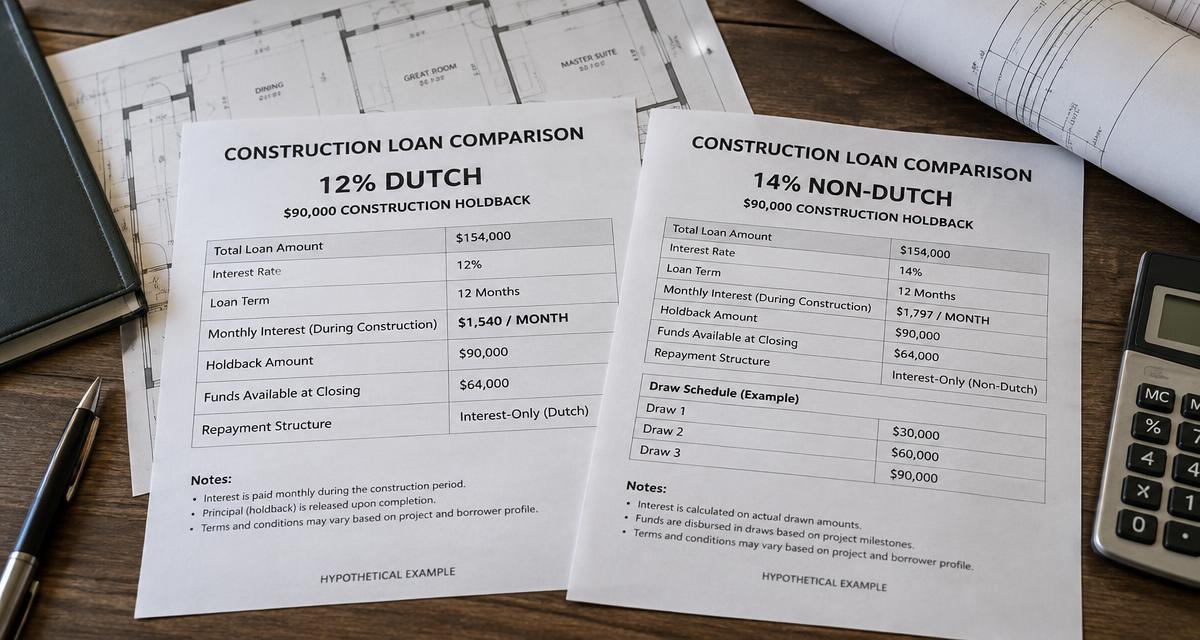
12% vs. 14% Construction Loans: Which Costs Less?
Interest rates matter, but fees, construction draws and payoff timing determine total cost. Compare 12% full commitment interest with 14% on disbursed funds using a transparent hypothetical example.
Construction Financing
Soft Cost Financing in Florida: Funding Your Project Before Construction
Soft cost financing helps Florida borrowers pay eligible predevelopment expenses such as architectural drawings, engineering, surveys, site investigations and permit fees before construction begins. Eligibility depends on the property, the borrower and the project review.

Construction Financing
What Happens When a Construction Loan Expires Before the Project Is Finished? | Florida Guide
An unfinished construction project does not automatically extend a maturing loan. This Florida guide explains extensions, modifications, refinancing, unused draws, updated appraisals, cost overruns and the documents lenders may review.
Construction Financing
You Split One Property Into Two Lots, but the Lender's Lien Is Still on Both. What Happens to Your Construction Loan?
A lot split does not automatically split an existing lien. This Florida guide explains partial lien releases, why an updated appraisal cannot remove a recorded lien, who approves a release, how construction lenders evaluate lien position, and the documents to have ready before applying.
Construction Financing
Land Acquisition + Construction Financing in Florida: Can Both Be Included in One Loan?
A Florida developer's guide to combining land acquisition and construction financing in one loan: how acquisition advances and construction draws work, LTC vs. LTV, land equity as contribution, what costs are and are not funded, and what lenders need to approve the request.
Construction Financing
Ground-Up Construction vs. Heavy Rehab Financing in Florida
Ground-up construction financing builds a new property from vacant land or after demolition. Heavy rehab financing funds major renovation of an existing structure. Here is how Florida private lenders underwrite each, with worked LTC and ARV examples.
Construction Financing
Construction Loan Draw Schedule Explained: How Private Lenders Release Funds
Construction loans do not fund in one lump sum. Funds release in stages tied to completed milestones. Here is the typical draw schedule, the documentation each request needs, how inspections and interest work, and why draws get delayed.

Investor Education
Upfront Due Diligence Deposits: How Florida Borrowers Can Avoid Costly Financing Mistakes
Know who receives your money, what work it covers and what happens if financing fails. A practical Florida guide to upfront deposits, written fee terms and independent verification.
Bridge Loans
Commercial Bridge Loans in Florida: A Complete Guide to $5M to $20M Financing
The pillar guide to commercial bridge loans in Florida: what they are, who they fit, how LTV sizes a $5M to $20M request, what documents lenders need, how appraisals and exit strategies drive approval, and when bridge financing is the wrong tool.
Investor Education
What Is an Interest Reserve in a Construction Loan? A Complete Guide for Builders and Contractors
An interest reserve covers construction loan interest from loan proceeds while the property produces no income. Here is how lenders size it, how it interacts with the draw schedule, and what happens when a build runs long.
Construction Loans
What Is a Construction Loan in Florida? The Complete Investor Guide (2026)
A complete 2026 guide to construction loans in Florida, how draw schedules work, who qualifies, private vs. bank financing, LTC and LTV, Florida-specific building challenges, real examples, and the mistakes investors should avoid.

Investor Education
First-Lien vs. Second-Lien Loans: What Real Estate Investors Need to Know
A first lien holds the senior claim against a property while a second lien sits behind it. Here is how lien priority works, how LTV and CLTV differ, why equity drives second position financing, and how Florida records and ranks liens.