Construction Financing
Ground-Up Construction vs. Heavy Rehab Financing in Florida
Published By Luminary Private Lending
- Author:
- Ivan Padilla
- Reviewed By:
- Kevin Mazzola
- Published:
- August 28, 2026
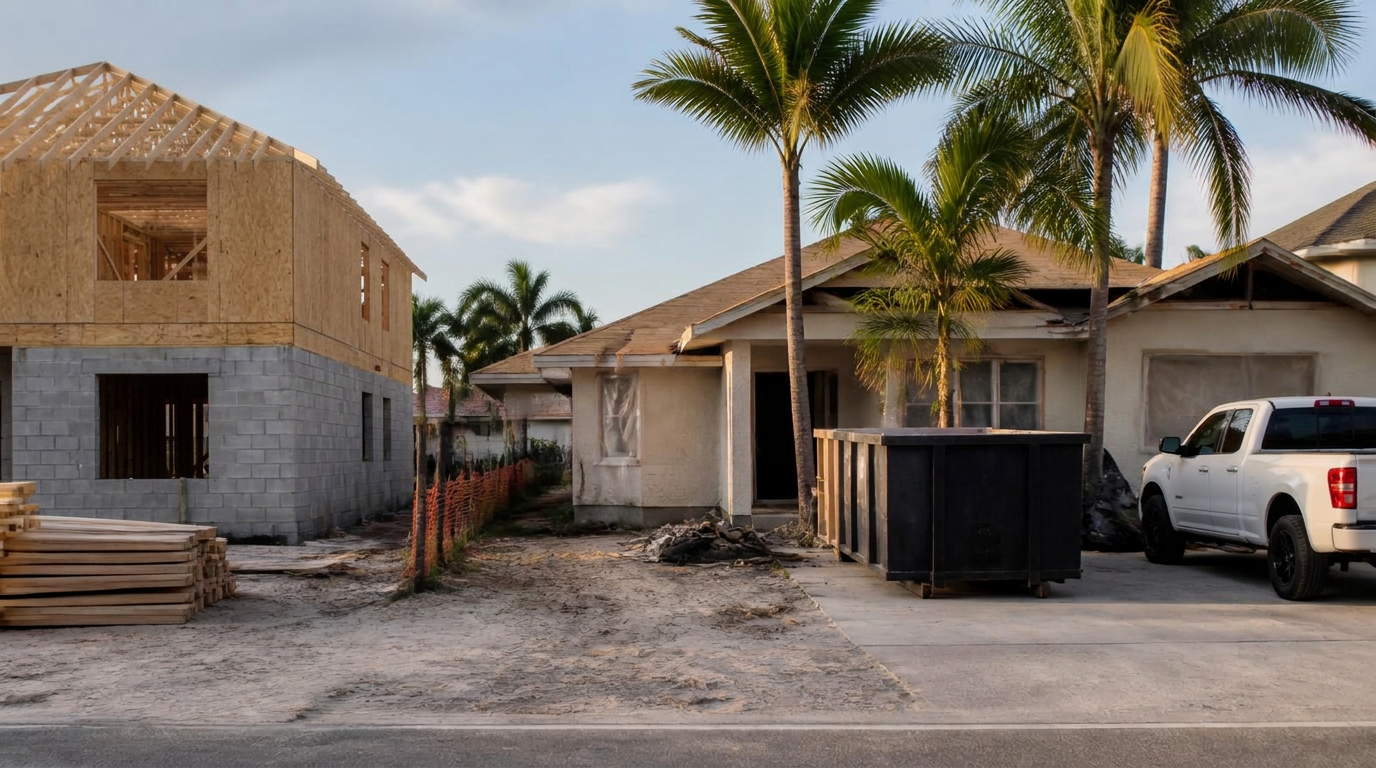
Ground-up construction financing builds a new property from vacant land or after demolition. Heavy rehab financing funds major renovation of an existing structure. Here is how Florida private lenders underwrite each, with worked LTC and ARV examples.
Ground-up construction vs. heavy rehab financing is the first structural decision a Florida investor makes on any build or renovation deal. Ground-up construction financing funds a new building on vacant land or on a site after demolition. Heavy rehab financing funds major renovation of a structure that already exists. Both use construction draws, but Florida construction loans of each type are appraised, budgeted, and underwritten differently.
Last updated: August 28, 2026.
Table of Contents
- Ground-Up Construction vs. Heavy Rehab Financing: What's the Difference?
- At a Glance Comparison Table
- What Is Ground-Up Construction Financing?
- What Is Heavy Rehab Financing?
- When Does a Rehab Become a Construction Project?
- How Lenders Value a Ground-Up Project
- What Is LTC in Construction Financing?
- What Is ARV in Heavy Rehab Financing?
- Two Worked Examples, Side by Side
- Can Land Equity Count Toward a Construction Loan?
- How Construction and Rehab Funds Are Released
- Do You Pay Interest on the Entire Construction Loan?
- Documents Lenders Typically Request
- Which Is Riskier?
- What Happens If the Project Goes Over Budget?
- What Happens If Construction Takes Longer Than Expected?
- Exit Strategies After Construction
- Which Loan Is Right for My Project?
- Ground-Up and Heavy Rehab Financing in Florida
- Frequently Asked Questions
Ground-Up Construction vs. Heavy Rehab Financing: What's the Difference?
The key difference between ground-up construction financing and heavy rehab financing is the condition of the property when the project begins.
A ground-up construction loan finances the building of a new structure. The project usually begins with vacant land, or with a site where an existing building will be demolished first.
A heavy rehab loan finances substantial improvements to a property that already exists. The building is standing, but the renovation may involve structural, mechanical, electrical, plumbing, roofing, or full interior work.
For real estate investors and developers seeking construction financing in Florida, the distinction is practical rather than academic. Project type drives the appraisal, the construction budget, the loan amount, the draw schedule, contractor requirements, the timeline, and the exit strategy.
Ground-Up Construction vs. Heavy Rehab at a Glance
| Factor | Ground-Up Construction | Heavy Rehab |
|---|---|---|
| Starting point | Vacant land or a demolition site | Existing structure |
| Primary goal | Build a new property | Renovate or reposition a property |
| Construction budget | Typically large and fully scoped | Varies with renovation scope |
| Appraisal | As-is land value plus subject-to-completion value | Current value plus after-repair value |
| Funding | Released through construction draws | Released through staged draws |
| Contractor | Experienced licensed GC commonly required | Depends on scope and lender |
| Plans | Detailed construction plans typically required | Scope of work, plans if structural |
| Permits | New-construction permits | Renovation permits by scope |
| Primary metric | Loan to cost with completed-value check | Current value, rehab budget, ARV |
| Exit strategy | Sale, refinance, or hold | Sale, refinance, or hold |
What Is Ground-Up Construction Financing?
Ground-up construction financing is used when a borrower intends to build a new property rather than purchase or renovate one that exists. The project may begin on raw land, or an older structure may be demolished before new construction starts.
Ground-up construction loans in Florida commonly support:
- Single-family investment homes
- Spec homes
- Build-to-rent properties
- Multifamily developments
- Townhomes
- Mixed-use developments
- Selected commercial construction projects
Construction financing does not work like a traditional mortgage. The full construction budget is generally not advanced at closing. Funds are released through a draw schedule as work is completed, which typically tracks site preparation, foundation, framing, roofing, mechanical systems, drywall, interior finishes, and final completion. You can learn how construction loan draw schedules work in our dedicated guide.
What Is Heavy Rehab Financing?
Heavy rehab loans in Florida are used when an existing property requires substantial renovation that goes well beyond cosmetic improvements such as paint, flooring, countertops, or appliances.
A heavy rehabilitation project may involve:
- Structural repairs and foundation work
- Roof replacement
- Major electrical upgrades and plumbing replacement
- HVAC replacement
- Significant floor-plan changes or load-bearing wall modifications
- Additions to the property
- Extensive fire or water-damage restoration
- Full interior gut renovations
- Major code-compliance improvements
The exact definition of heavy rehab varies by lender. One lender may classify a project by renovation budget, another by whether structural components change. Borrowers should present a clear scope of work and a line-item budget when requesting financing.
When Does a Rehab Become a Construction Project?
No fixed dollar amount or renovation percentage converts a rehab into ground-up construction. Classification generally depends on scope.
- Existing building plus large renovation equals heavy rehab.
- Vacant land or demolition plus a new building equals ground-up construction.
Projects with major additions, extensive structural change, or a near-total rebuild usually require additional review. The lender evaluates the plans, budget, property condition, and the proposed finished property, then selects the appropriate loan structure.
How Do Lenders Determine the Value of a Ground-Up Construction Project?
Because the finished building does not yet exist, a construction appraisal often reports more than one value.
As-is value
The as-is value reflects what the property is worth in its current condition. On a ground-up project sited on vacant land, this is generally the value of the land itself.
Subject-to-completion value
The subject-to-completion value estimates what the property should be worth once construction is finished, based on the plans and specifications supplied to the appraiser. This projected value is central to construction underwriting, but a strong projected value does not by itself commit a lender to fund the entire construction budget. Loan to cost is evaluated alongside it.
What Is LTC in Construction Financing?
Loan to cost compares the loan amount to the total cost of the project.
LTC = Loan Amount ÷ Total Project Cost × 100
- Land or project basis: $100,000
- Construction costs: $400,000
- Total project cost: $500,000
- Construction loan: $400,000
$400,000 divided by $500,000 equals 80 percent LTC. Lenders generally test both cost and projected completed value, and the maximum loan amount is the lower of the two program limits. To go deeper, understand LTC in construction financing alongside LTV and ARV.
What Is ARV in Heavy Rehab Financing?
ARV means after-repair value. It is the expected market value of the property once the planned renovation is complete.
An investor may own a property valued at $300,000 today and plan $150,000 of improvements. If comparable renovated properties support roughly $600,000, the ARV may be estimated near $600,000. The lender still weighs current value, purchase price or basis, renovation budget, existing liens, borrower equity, contractor experience, scope of work, and exit strategy. The appraisal establishes the supported value.
Two Worked Examples, Side by Side
Ground-up construction example
| Item | Amount |
|---|---|
| Land value (owned free and clear) | $150,000 |
| Construction budget | $550,000 |
| Total project cost | $700,000 |
| Subject-to-completion value | $950,000 |
| Requested loan | $525,000 |
| Loan to cost | 75 percent |
| Loan to completed value | 55 percent |
Both tests are satisfied in this illustration, and the land equity contributes meaningfully to the borrower's position in the deal.
Heavy rehab example
| Item | Amount |
|---|---|
| Purchase price or current value | $320,000 |
| Rehab budget | $180,000 |
| Total project cost | $500,000 |
| After-repair value | $700,000 |
| Requested financing | $375,000 |
| Loan to cost | 75 percent |
| Loan to ARV | 54 percent |
These figures are illustrative only. Actual leverage depends on underwriting, appraisal, property type, and program guidelines.
Can Land Equity Be Used Toward a Ground-Up Construction Loan?
Potentially, yes. If the borrower already owns the land, equity in that parcel may form an important part of the financing structure. An investor who owns a Florida lot free and clear with a $150,000 appraised value and no liens holds $150,000 of equity.
How much of that equity counts as the borrower's contribution depends on lender guidelines, the appraisal, total project cost, and how the transaction is structured. Owning land in advance is often valuable, but a dollar of land equity is not automatically treated as a dollar of cash contribution.
How Are Construction and Rehab Funds Released?
Construction lenders generally fund through draws rather than releasing the full budget at closing. A simplified schedule may look like this:
| Draw | Typical work covered |
|---|---|
| Draw 1 | Initial eligible project costs and site preparation |
| Draw 2 | Foundation and structural work |
| Draw 3 | Framing, roofing, plumbing, electrical, HVAC |
| Draw 4 | Drywall, flooring, cabinets, fixtures, interior finishes |
| Final draw | Completion of remaining approved work |
Before releasing a draw, the lender may require an inspection or documentation confirming the work was completed. The actual schedule depends on project size and complexity.
Do You Pay Interest on the Entire Construction Loan?
It depends on the loan structure. Many construction loans charge interest only on funds that have been advanced. If a lender approves $600,000 and only $150,000 has been drawn, interest typically accrues on the $150,000 outstanding rather than the full commitment. As draws are released, the balance grows and interest payments rise with it. Some structures fund those payments from an interest reserve inside the construction loan. Always confirm the calculation method in the loan documents.
What Documents Are Usually Needed?
Ground-up construction financing
- Property address or parcel information
- Construction plans and a detailed line-item budget
- General contractor agreement, license, and experience
- Construction timeline
- Permits or permit status
- Property appraisal
- Entity documents and, where applicable, a personal financial statement
- Schedule of real estate owned
- Evidence of existing liens or mortgages
- Insurance information and exit strategy
Heavy rehab financing
- Purchase contract, if applicable
- Existing mortgage information
- Detailed scope of work and rehab budget
- Contractor agreement and credentials
- Plans for any structural changes
- Permits or permit status
- Current property information and appraisal
- Estimated project timeline and exit strategy
The more complex the project, the more detailed the underwriting review becomes.
Which Is Riskier: Ground-Up Construction or Heavy Rehab?
Both carry construction risk, but of different kinds. Ground-up construction begins with no completed structure, so the lender is underwriting whether the project can be delivered on budget and on schedule. Heavy rehab involves an existing building, which introduces unknown conditions. Once demolition begins, a contractor may uncover foundation problems, outdated electrical systems, plumbing damage, mold, or structural decay that was not visible during inspection. A realistic budget and a funded contingency matter in both cases.
What Happens If the Project Goes Over Budget?
Approval of a construction loan does not obligate a lender to fund cost overruns. If a project budgeted at $500,000 requires $575,000 to complete, the additional $75,000 has to come from somewhere, and the borrower is often the source. This is why experienced developers carry a construction contingency and confirm liquidity before breaking ground.
What Happens If Construction Takes Longer Than Expected?
Delays are common. Permit review, material availability, contractor scheduling, weather, inspections, change orders, unexpected site conditions, utility connections, and supply-chain issues all affect timelines. If construction runs past the loan maturity date, the borrower may need an extension, a refinance, or another resolution, depending on the loan agreement. Review the term and extension provisions before closing.
What Exit Strategies Are Available After Construction?
A construction loan is generally temporary financing. Borrowers typically choose one of three exits.
- Sell the property. Spec builders repay the construction loan from sale proceeds.
- Refinance into long-term financing. Completed projects are refinanced into longer-term debt.
- Stabilize, then refinance. Rental, multifamily, and commercial projects are completed, leased, and refinanced once operating income supports permanent financing.
A credible exit is a central part of the lender's underwriting.
Which Loan Is Right for My Project?
| Your situation | Likely financing |
|---|---|
| Vacant land you own or are buying | Ground-up construction |
| Existing structure will be demolished and rebuilt | Ground-up construction |
| Spec home or build-to-rent development | Ground-up construction |
| Existing structure with major renovation | Heavy rehab |
| Structural repairs or repositioning an asset | Heavy rehab |
| Full gut with significant structural changes | Lender review of plans and budget |
| Land purchase with no immediate build | Vacant land financing |
Ground-Up Construction and Heavy Rehab Financing in Florida
Florida projects range from single-family homes and luxury spec homes to multifamily, mixed-use, and commercial buildings. Conditions vary widely across Miami, Fort Lauderdale, West Palm Beach, Naples, Fort Myers, Tampa, St. Petersburg, Orlando, and Jacksonville. Land costs, construction costs, permitting timelines, insurance requirements, and completed values differ market by market, so one lending formula cannot be applied to every Florida development.
Several Florida-specific factors deserve attention early in the budget:
- Building code and wind requirements. Construction is governed by the Florida Building Code, and High-Velocity Hurricane Zone provisions apply in Miami-Dade and Broward counties. See the Florida Building Commission for current code editions.
- Flood zones and elevation. Coastal and inland flood zones affect design, elevation certificates, and cost. Flood mapping is published by FEMA's Flood Map Service Center.
- Contractor licensing. Construction licensing in Florida is administered through the Department of Business and Professional Regulation, and lenders generally verify the general contractor's license status.
- Permitting timelines. Review and inspection schedules are handled locally, so timelines differ between a coastal municipality and an inland county.
- Builder's risk and windstorm insurance. Coverage requirements and premiums vary by county and proximity to the coast, and they belong in the project budget rather than in a surprise line item later.
Frequently Asked Questions
The questions below reflect what Florida investors most often ask when comparing ground-up construction and heavy rehab financing.
Submit Your Construction Project for Review
Deciding between ground-up construction financing and heavy rehab financing starts with the property you have today and the property you intend to deliver. A lender will typically want to know current value, completed value, project cost, existing equity, who is building it, and how the loan will be repaid.
Luminary Private Lending is a Florida private real estate lender providing asset-based construction financing for investors, builders, and entities across the state. Send your property information, construction budget, project plans, and requested loan amount for review. If you are not certain whether your project is ground-up or heavy rehab, submit it and we will assess the appropriate structure. Review our construction financing program or contact the Luminary team.
Key Takeaway
Ground-up construction and heavy rehab financing both fund real estate improvement, but they support very different projects. Ground-up construction financing is designed to create a new building. Heavy rehab financing is designed to substantially renovate an existing one. Choosing correctly involves more than loan size. Current value, completed value, construction cost, borrower equity, project team, timeline, and exit strategy all shape the terms.
Author and Reviewer
Author. Ivan Padilla, Director of Growth and Real Estate Lending Specialist, Luminary Private Lending. Ivan works daily with Florida investors and builders on bridge, construction, second mortgage, and vacant land financing. Meet the Luminary team.
Reviewed by. Kevin Mazzola, Founder of Luminary Private Lending. Kevin has structured asset-based construction and renovation financing for investors and entities throughout Florida.
Published: August 28, 2026. Last updated: August 2026. Last reviewed: August 28, 2026. This article is educational only and is not a commitment to lend. Loan programs, terms, eligibility, rates, fees, leverage, and underwriting requirements can change and may vary by transaction. All financing is subject to underwriting, property review, appraisal, title review, and final approval.
Related Florida Lending Resources
Keep Reading
Latest Insights
Keep exploring Florida private lending insights.
Construction Financing
Soft Cost Financing in Florida: Funding Your Project Before Construction
Soft cost financing helps Florida borrowers pay eligible predevelopment expenses such as architectural drawings, engineering, surveys, site investigations and permit fees before construction begins. Eligibility depends on the property, the borrower and the project review.
Construction Financing
What Happens When a Construction Loan Expires Before the Project Is Finished? | Florida Guide
An unfinished construction project does not automatically extend a maturing loan. This Florida guide explains extensions, modifications, refinancing, unused draws, updated appraisals, cost overruns and the documents lenders may review.
Construction Financing
Land Acquisition + Construction Financing in Florida: Can Both Be Included in One Loan?
A Florida developer's guide to combining land acquisition and construction financing in one loan: how acquisition advances and construction draws work, LTC vs. LTV, land equity as contribution, what costs are and are not funded, and what lenders need to approve the request.
Construction Financing
12% vs. 14% Construction Loans: Which Costs Less?
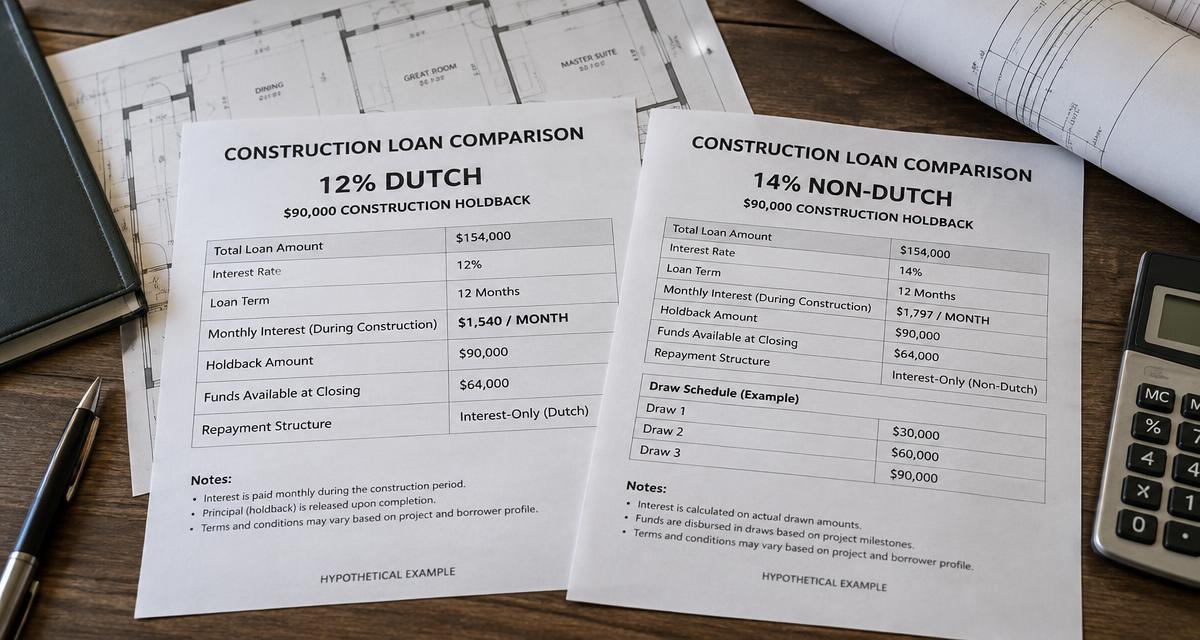
Interest rates matter, but fees, construction draws and payoff timing determine total cost. Compare 12% full commitment interest with 14% on disbursed funds using a transparent hypothetical example.
Construction Financing
You Split One Property Into Two Lots, but the Lender's Lien Is Still on Both. What Happens to Your Construction Loan?
A lot split does not automatically split an existing lien. This Florida guide explains partial lien releases, why an updated appraisal cannot remove a recorded lien, who approves a release, how construction lenders evaluate lien position, and the documents to have ready before applying.

Construction Financing
Dutch vs. Non-Dutch Interest on Construction Loans: What Borrowers Need to Know
Dutch interest is calculated on the full construction loan commitment. Non-Dutch interest is calculated on funds actually advanced. Worked $2 million examples, a full 12-month draw table, a Naples scenario and an interactive calculator show why a 12% loan can cost less than a 10% loan.
Construction Financing
Construction Loan Draw Schedule Explained: How Private Lenders Release Funds
Construction loans do not fund in one lump sum. Funds release in stages tied to completed milestones. Here is the typical draw schedule, the documentation each request needs, how inspections and interest work, and why draws get delayed.

Investor Education
Upfront Due Diligence Deposits: How Florida Borrowers Can Avoid Costly Financing Mistakes
Know who receives your money, what work it covers and what happens if financing fails. A practical Florida guide to upfront deposits, written fee terms and independent verification.
Bridge Loans
Commercial Bridge Loans in Florida: A Complete Guide to $5M to $20M Financing
The pillar guide to commercial bridge loans in Florida: what they are, who they fit, how LTV sizes a $5M to $20M request, what documents lenders need, how appraisals and exit strategies drive approval, and when bridge financing is the wrong tool.
Florida Real Estate Market
Florida Housing Construction Trends 2026: What Fewer Building Permits Mean for Real Estate Investors
Florida building permits have slowed in 2026. Here's what fewer new construction starts mean for investors, plus the loan programs that help you move faster than traditional banks.

Vacant Land Financing
Vacant Land Financing in Florida (2026 Investor Guide)
A complete 2026 guide to vacant land financing in Florida, how it works, qualifying land types, exit strategies, comparison to construction and bridge loans, real investment examples, common mistakes, and a full investor checklist.
Construction Loans
What Is a Construction Loan in Florida? The Complete Investor Guide (2026)
A complete 2026 guide to construction loans in Florida, how draw schedules work, who qualifies, private vs. bank financing, LTC and LTV, Florida-specific building challenges, real examples, and the mistakes investors should avoid.