Second Mortgages
When Should You Take a Second Mortgage? Florida Investor Guide (2026)
Published By Luminary Private Lending
- Author:
- Ivan Padilla
- Reviewed By:
- Kevin Mazzola
- Published:
- July 11, 2026
A 2026 guide for Florida real estate investors on business-purpose second mortgages, when they make sense, when to avoid them, comparisons to bridge loans and cash-out refinancing, real Florida examples, and a full FAQ.
Every real estate investor eventually reaches a point where new opportunities require more capital. A new investment property, a renovation, a vacant land purchase, or working capital for a growing real estate business, all take money. A business-purpose second mortgage can unlock the equity in a Florida investment property without disturbing a favorable first mortgage.
Quick Answer
A business-purpose second mortgage may be a good option when a Florida real estate investor wants to access equity without replacing an existing first mortgage. It's commonly used to purchase investment property, renovate rentals, finance construction, or expand a real estate portfolio while preserving favorable mortgage terms.
In this guide you'll learn
- What a second mortgage is
- When it makes sense for investors
- When you should avoid one
- Benefits and risks
- Second mortgage vs. bridge loan
- Second mortgage vs. cash-out refinance
- Qualification requirements
- Frequently asked questions
Who This Guide Is For
- ✓ Rental property investors
- ✓ Fix-and-flip investors
- ✓ Commercial investors
- ✓ Developers
- ✓ Land investors
- ✓ LLC and entity owners
- ✓ Real estate entrepreneurs
Who This Isn't For
This guide may not apply if you're looking for personal loans, consumer home equity loans, primary residence financing, auto loans, credit card consolidation, or vacation financing. Business-purpose second mortgages are designed for real estate investment activity, not personal spending.
Table of Contents
- What Is a Second Mortgage?
- How It Works
- Florida Equity Market Snapshot (2026)
- Why Investors Choose It Over Refinancing
- When Should You Take a Second Mortgage?
- When Should You Not Take One?
- Benefits and Risks
- Second Mortgage vs. Bridge Loan
- Second Mortgage vs. Cash-Out Refinance
- Luminary Loan Comparison Matrix
- Equity Calculation Example
- Real Florida Examples
- Common Mistakes to Avoid
- Glossary
- Frequently Asked Questions
What Is a Second Mortgage?
A second mortgage is a loan secured by your property's equity that sits behind, and preserves, your existing first mortgage. When the property sells or is refinanced, the first lien is paid off before the second. Unlike a cash-out refinance, a second mortgage does not replace your original loan, which is why investors with favorable existing terms often prefer it.
Business-purpose second mortgages help investors access equity for real estate activity: buying another investment property, financing renovations, funding construction, acquiring vacant land, or providing working capital for a real estate business.
How a Business-Purpose Second Mortgage Works
Consider your property's equity an asset that can help fund your next investment. A simple example:
- Current property value: $800,000
- First mortgage balance: $350,000
- Available equity: $450,000
Depending on the property, existing debt, and lender guidelines, you may be able to access a portion of that equity through a second mortgage. Your original loan, rate, term, and monthly payment, stays exactly as it is.
Typical Workflow
- Submit your financing request, property info, loan balance, estimated value, requested amount, business purpose, and exit strategy.
- Property review, the lender evaluates value, marketability, and available equity against loan-to-value guidelines.
- Underwriting, private lenders focus on equity, experience, business purpose, and exit strategy rather than traditional income documentation.
- Closing, documents are signed and the loan is funded, often faster than a traditional bank timeline.
Florida Equity Market Snapshot (2026)
Recent public data highlights why Florida remains one of the strongest equity markets in the country:
- Population growth: Florida added roughly 365,000 new residents in the latest annual estimate (U.S. Census Bureau, Vintage 2024 population estimates).
- Homeowner equity: CoreLogic's Homeowner Equity Insights consistently ranks Florida among the top states for average annual equity gains per mortgaged homeowner.
- Home price trend: The FHFA House Price Index shows Florida among the leading states for cumulative appreciation over the last five years.
- Investor activity: National Association of Realtors (NAR) data continues to rank Florida among the top destinations for investor and second-home purchases.
- Mortgage rates: Freddie Mac's Primary Mortgage Market Survey shows 30-year rates well above the sub-4% loans many investors locked in years ago, a key reason many prefer to preserve their first mortgage.
- Housing inventory: MBA and Realtor.com data show Florida markets rebalancing but still constrained versus long-term averages.
Why Investors Choose a Second Mortgage Instead of Refinancing
Many Florida investors locked in historically low rates over the past several years. Refinancing today may replace that loan with a higher rate, reset the term, and add closing costs. A second mortgage lets qualified investors keep their original mortgage while tapping equity for business needs.
Investor Tip
Preserving a low-rate first mortgage can be worth as much as, or more than, the interest cost of a short-term second, especially when the second mortgage is designed to be repaid quickly through a sale, refinance, or business cash flow.
When Should You Take a Second Mortgage?
A second mortgage isn't right for every situation. The best candidates have real business purpose, sufficient equity, and a clear exit strategy. Common scenarios:
- You want to buy another investment property. An investor owning a rental in Tampa with strong equity may use a second mortgage to fund a new acquisition in Jacksonville.
- You need capital for property renovations. Kitchens, roofs, HVAC, energy-efficient upgrades, strategic improvements often lift both value and rental income.
- You're financing a fix-and-flip project in a market like Orlando or Fort Myers.
- You want to preserve your low first mortgage rate, one of the most common reasons investors choose a second over refinancing.
- A time-sensitive opportunity comes up, auctions, distressed sales, off-market deals in Miami-Dade or Broward.
- You need funding for a construction project, pair with our construction financing.
- You want to buy vacant land in growth corridors like Ocala, Sarasota, or Naples.
- Your real estate business needs working capital for marketing, contractors, equipment, insurance, or unexpected repairs.
- You want to expand your portfolio without selling appreciating assets.
- You have a clear exit strategy, sale, refinance, rental income, business revenue, or proceeds from another property.
Ready to talk to a lending specialist?
Every scenario is different. Our team can review your property and goals in a short conversation. Get Started → or Contact us.
When Should You Not Take a Second Mortgage?
- You don't have a clear exit strategy.
- You're borrowing for personal expenses, business-purpose loans don't cover vacations, vehicles, or credit card debt.
- You don't have enough available equity.
- You can't comfortably afford the additional payment.
- Your investment doesn't produce enough value to justify the financing cost.
- You're looking for long-term owner-occupied primary residence financing.
Benefits and Risks
Benefits
- Preserve your existing first mortgage
- Access equity without selling
- Expand your investment portfolio
- Faster financing than traditional banks
- Flexible business uses
Potential Risks
- Additional monthly loan payment
- Reduced available equity in the property
- Financing costs and closing expenses
- Market changes that may affect property values
- Project delays that impact the planned exit strategy
Common Mistake
Borrowers who underestimate carrying costs, taxes, insurance, and the new second-mortgage payment, during renovation or construction timelines. Always model 3–6 months of buffer.
Second Mortgage vs. Bridge Loan
A second mortgage taps the equity in a property you already own; a bridge loan typically funds the acquisition or short-term refinance of a new property. Bridge loans are ideal for time-sensitive purchases, auctions, and distressed properties. Second mortgages are ideal for unlocking equity without touching the first lien.
Second Mortgage vs. Cash-Out Refinance
A cash-out refinance replaces your existing mortgage with a new, larger loan at today's rate. A second mortgage leaves the first mortgage untouched and creates a separate loan against the equity. For investors with favorable existing terms, a second mortgage is often the more cost-effective way to access capital.
Luminary Loan Comparison Matrix
| Loan | Best For | Typical Term | Primary Use |
|---|---|---|---|
| Bridge Loan | Fast acquisitions | 12–24 months | Purchase / refinance |
| Construction Loan | Ground-up builds | Draw schedule | Construction |
| Vacant Land | Land purchases | Short-term | Land acquisition |
| Second Mortgage | Unlock equity | Short-term | Business capital |
Equity Calculation Example
- Property Value: $900,000
- First Mortgage: $400,000
- Available Equity: $500,000
- Potential CLTV Limit: Illustrative only, actual eligibility depends on lender guidelines.
Real Florida Examples
- Miami: An investor pulls equity from a Brickell condo to fund a Little Havana fix-and-flip.
- Tampa: A South Tampa rental owner uses a second mortgage to acquire a duplex in Seminole Heights.
- Jacksonville: A landlord in Riverside finances a roof replacement across two rentals.
- Naples: A vacation rental owner unlocks equity to buy an additional short-term rental near the beach.
- Sarasota: A developer taps equity to close on infill land for a small townhome project.
- Fort Myers: A post-hurricane rebuild is funded by a second mortgage on an unimpaired rental.
- Orlando: An investor pulls equity from a Winter Park rental to purchase an Airbnb near the theme parks.
- Ocala: A land investor uses a second mortgage to acquire acreage along a growth corridor.
Common Mistakes to Avoid
- Borrowing too much relative to available equity
- No clear exit strategy
- Underestimating renovation costs
- Ignoring carrying costs during the hold period
- Waiting too long to apply for a time-sensitive deal
- Choosing the wrong loan product for the scenario
Why Investors Work With Luminary
- Florida-focused private lender
- Fast preliminary reviews
- Business-purpose financing
- Multiple investment loan programs
- Experienced lending team
- Relationship-focused approach
Glossary
- Equity: Property value minus all debt secured by it.
- LTV: Loan-to-Value, loan amount divided by property value.
- CLTV: Combined Loan-to-Value, all liens divided by property value.
- Exit Strategy: The planned method of repaying the loan.
- Underwriting: The lender's review and approval process.
- Appraisal: A professional opinion of the property's market value.
- Title: Legal ownership documentation and lien status.
- First Lien: The primary loan secured by the property.
- Second Lien: A loan recorded behind the first lien.
- Bridge Loan: Short-term financing to "bridge" between transactions.
- Cash-Out Refinance: Replacing an existing mortgage with a larger one and taking the difference in cash.
Ivan Padilla's Perspective
From Ivan Padilla, Luminary Private Lending
"One of the biggest mistakes we see is investors refinancing a 3% first mortgage just to access equity. In many situations, preserving that low-rate financing while using a business-purpose second mortgage may be the more strategic option."
"When investors call us about a fix-and-flip, we're not just underwriting the property, we're stress-testing the exit. A second mortgage without a realistic sale or refinance plan is a hold problem waiting to happen."
"Florida moves fast. The investors who consistently win off-market deals in Miami-Dade, Tampa, and Orlando are the ones who already know their available equity before the opportunity shows up, not after."
"CLTV isn't just a number, it's your margin of safety. When we structure a second mortgage, we're leaving room for insurance shifts, tax reassessments, and the natural friction of a Florida market that's still normalizing."
"The most durable investor businesses we finance treat capital access as infrastructure, not an event. Having a second-mortgage relationship in place before you need it is what turns a good year into a great one."
Second Mortgage Decision Tree
Do you already own investment property in Florida?
        │
        ▼
      YES
        │
        ▼
Do you have available equity?
        │
        ▼
      YES
        │
        ▼
Is the purpose business / real estate related?
        │
        ▼
      YES
        │
        ▼
Do you want to keep your existing first mortgage?
        │
        ▼
      YES
        │
        ▼
Do you have a clear exit strategy?
        │
        ▼
      YES
        │
        ▼
A business-purpose Second Mortgage may be appropriate.
Which Luminary Loan Fits You?
| If you want to… | Consider… |
|---|---|
| Buy quickly or refinance short-term | Bridge Loan |
| Build from the ground up | Construction Loan |
| Buy land | Vacant Land Financing |
| Unlock equity without refinancing | Second Mortgage |
Before You Apply Checklist
- ✔ Current mortgage balance
- ✔ Estimated property value
- ✔ Exit strategy
- ✔ Property address
- ✔ Investment purpose
- ✔ LLC information (if applicable)
- ✔ Timeline
- ✔ Renovation budget (if applicable)
Required Documents
Most lenders may request:
- Government-issued ID
- Property address and parcel information
- Current mortgage statement
- Insurance information
- Entity documents (LLC, LP, or corporation) and EIN, if applicable
- Purchase contract (when relevant)
- Scope of work (for renovations or construction)
- Exit strategy summary
Florida Market Trends to Watch in 2026
- Population migration: Continued inbound migration to Florida supports long-run rental demand and land values across Central, South, and Southwest Florida.
- Insurance costs: Elevated property insurance premiums have become a primary underwriting variable, model them into every proforma, especially in the Space Coast, Treasure Coast, and coastal Panhandle markets.
- Commercial demand: Industrial and mixed-use absorption remains healthy in the I-4 corridor and along Northeast Florida logistics hubs.
- Rental market trends: Rent growth has moderated from post-pandemic peaks but remains positive in most metros, with strongest performance in workforce-housing price bands.
- Interest rate environment: Rates remain well above the sub-4% loans many investors locked in, a structural reason to preserve existing first mortgages.
- Inventory levels: Listings have rebuilt from historic lows but are still constrained versus long-term averages, keeping well-located Florida real estate competitive.
Interactive Tools (Coming Soon)
To help investors evaluate scenarios, our team is building simple tools including an equity calculator, a CLTV calculator, a loan comparison tool, and a monthly payment estimator. Until they're live, our lending specialists can walk through the numbers with you directly. Contact us to run a scenario.
What Happens After You Apply?
- Submit your request, property, equity, and investment goals.
- Initial review, quick assessment of fit against program guidelines.
- Property evaluation, value, marketability, and equity confirmation.
- Underwriting, equity, business purpose, and exit strategy review.
- Loan terms, structure and documents provided for signature.
- Closing, signing with title / closing agent.
- Funding, proceeds disbursed to complete the transaction.
Not sure whether a bridge loan or second mortgage is the better fit?
Our lending specialists can review your investment goals and discuss potential financing options across our full product suite. Get Started → or talk to a specialist.
Related Guides
- If you're purchasing raw land, read our Vacant Land Financing Guide.
- Building from the ground up? See our Construction Loan Guide.
- Need fast acquisition financing? Explore our Bridge Loan Guide.
- Investing across the state? Start at our Florida Private Lending hub.
Where We Lend Across Florida
Luminary Private Lending works with investors across every major Florida region: Central Florida (Orlando, Ocala), South Florida (Miami-Dade, Broward, Palm Beach), Southwest Florida (Naples, Fort Myers, Sarasota), the Space Coast, the Treasure Coast, the Panhandle, and Northeast Florida (Jacksonville and surrounding counties).
Key Takeaways
- A second mortgage lets you preserve your first mortgage.
- It's designed for qualifying business-purpose real estate financing.
- A clear exit strategy is essential.
- Compare all available financing options before choosing.
- Work with an experienced Florida private lender.
Frequently Asked Questions
See the FAQ section below for common questions on second mortgages in Florida.
Final Thoughts
A business-purpose second mortgage is a useful tool for real estate investors, but only when it supports a real investment purpose, is backed by sufficient equity, and has a clear exit strategy. Used wisely, it can help you grow your portfolio, renovate properties, buy vacant land, or seize new opportunities while preserving the financing you've worked hard to secure.
If you have an investment property in Florida and want to explore whether a second mortgage fits your strategy, our team at Luminary Private Lending is ready to help.
Author: Ivan Padilla · Reviewed by: Kevin Mazzola · Last reviewed: July 2026 · Next scheduled review: January 2027 · Approximate reading time: 18 minutes.
Editorial note: this guide is reviewed periodically to reflect changes in Florida lending practices and market conditions.
Educational disclaimer: this article is informational and does not constitute a loan commitment or legal, tax, or investment advice. Programs, rates, and guidelines vary and change.
Related Florida Lending Resources
Keep Reading
Latest Insights
Keep exploring Florida private lending insights.
Second Mortgages
How Much Can You Borrow With a Second Mortgage in Florida?
Your potential second mortgage depends on the lender accepted property value, existing secured debt and the maximum combined loan to value. Under Luminary’s 50% CLTV guideline, an $800,000 property with a $250,000 first mortgage has $150,000 of preliminary capacity before underwriting adjustments and closing costs—not guaranteed approval or net cash.

Investor Education
What Does 125% Lender’s Title Insurance Mean? Florida Private Lending Guide
A 125% lender’s title insurance requirement means the policy amount equals 125% of the loan principal. It does not mean the borrower receives 25% more money or pays a 25% fee. On a $1,950,000 loan, 125% coverage equals $2,437,500; actual protection depends on the policy terms.

Investor Education
Can an LLC Get a Real Estate Loan Without Personal Credit? A Florida Private Lending Guide
An LLC real estate loan without personal credit as the deciding factor is possible with asset-based private lenders. This Florida guide covers what lenders review instead, LTV math with worked scenarios, new-LLC and free-and-clear situations, the difference between a credit pull and a personal guarantee, and a borrower document checklist.
Investor Education
What Is a Balloon Payment? A Complete Guide for Real Estate Investors in Florida
A balloon payment is a large final payment due at the end of a short term loan. Here is how balloon loans work, which programs use them, real Florida examples, the risks, and how investors plan an exit strategy before borrowing.

Vacant Land Financing
Vacant Land Financing in Florida (2026 Investor Guide)
A complete 2026 guide to vacant land financing in Florida, how it works, qualifying land types, exit strategies, comparison to construction and bridge loans, real investment examples, common mistakes, and a full investor checklist.

Construction Loans
What Is a Construction Loan in Florida? The Complete Investor Guide (2026)
A complete 2026 guide to construction loans in Florida, how draw schedules work, who qualifies, private vs. bank financing, LTC and LTV, Florida-specific building challenges, real examples, and the mistakes investors should avoid.

Bridge Loans
What Is a Bridge Loan in Florida? Complete 2026 Investor Guide
A complete 2026 guide to bridge loans in Florida, how they work, LTV, ARV, exit strategies, costs, timelines, three real case studies, common mistakes, and when a bridge loan is (and isn't) the right tool.
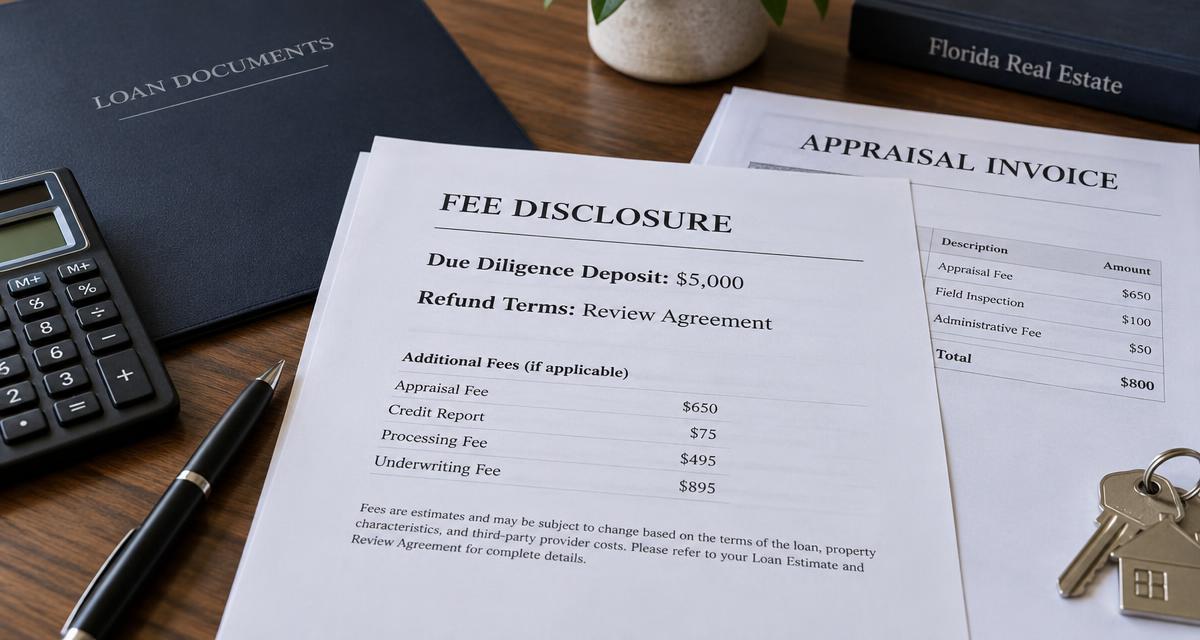
Investor Education
Upfront Due Diligence Deposits: How Florida Borrowers Can Avoid Costly Financing Mistakes
Know who receives your money, what work it covers and what happens if financing fails. A practical Florida guide to upfront deposits, written fee terms and independent verification.

Investor Education
Can You Get a Private Real Estate Loan Without Tax Returns in Florida?
Tax returns do not always reflect an investor's real financial strength. This Florida guide explains how asset-based private lenders evaluate property value, equity, loan-to-value, liquidity, use of funds and exit strategy instead of conventional income documentation.

Construction Financing
What Happens When a Construction Loan Expires Before the Project Is Finished? | Florida Guide
An unfinished construction project does not automatically extend a maturing loan. This Florida guide explains extensions, modifications, refinancing, unused draws, updated appraisals, cost overruns and the documents lenders may review.

Investor Education
Can a Newly Formed LLC Qualify for a Private Real Estate Loan in Florida?
A newly formed LLC may still qualify for private real estate financing in Florida. This guide explains what asset-based lenders review instead of operating history: property value, equity, liens, liquidity, the principals, documentation and the exit strategy.

Investor Education
Title Issues & Code Violations: Can They Get a Private Real Estate Loan Denied in Florida?
Strong equity and a supportive appraisal do not guarantee a closing. This Florida guide explains how title defects, recorded liens, municipal code liens, open permits and unpermitted work affect private lending, which issues are usually curable, what documentation to send up front, and why lien position matters as much as value.