Construction Financing
12% vs. 14% Construction Loans: Which Costs Less?
Published By Luminary Private Lending
- Author:
- Ivan Padilla
- Reviewed By:
- Kevin Mazzola
- Published:
- October 3, 2026
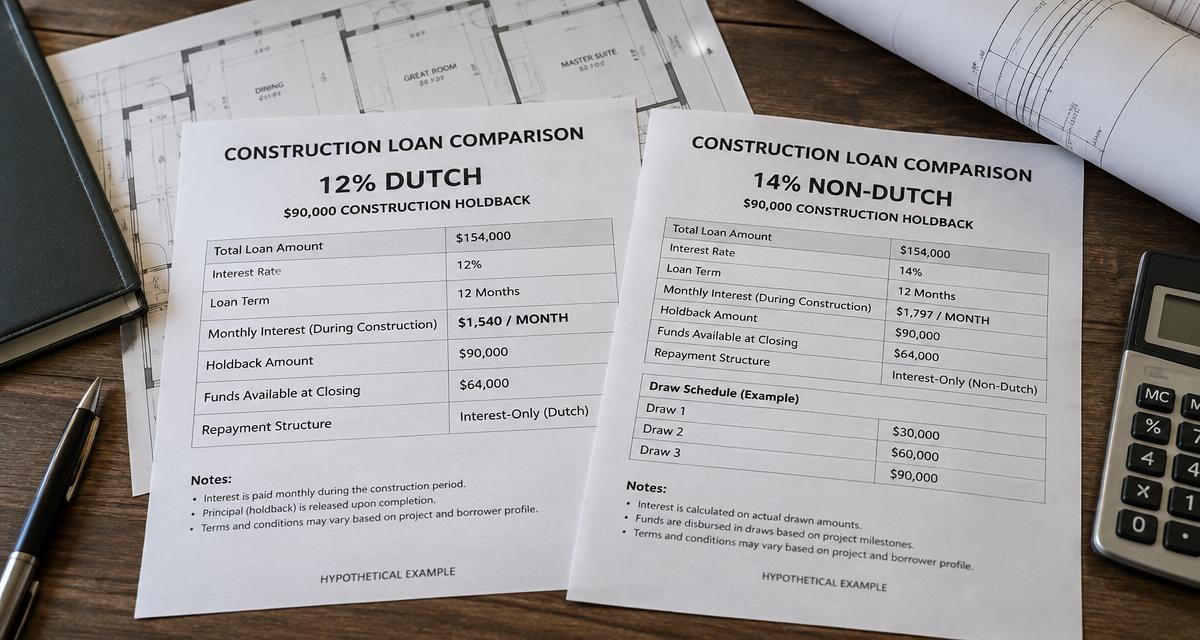
Interest rates matter, but fees, construction draws and payoff timing determine total cost. Compare 12% full commitment interest with 14% on disbursed funds using a transparent hypothetical example.
Yes, interest rates matter on short term construction projects, but total cost also depends on fees, disbursement timing, and the payoff date. For Florida investors comparing short term construction loan interest rates, a 12% rate on the entire commitment is not directly comparable to 14% interest on disbursed funds. Neither structure automatically costs less.
Quick Answer
A construction loan’s rate does not determine its total financing cost by itself. Compare the same initial advance, construction holdback, dated draw schedule, fees, and payoff timeline. A higher rate on disbursed funds can produce less interest early, but that advantage may shrink or reverse once all funds are drawn.
Key Takeaways
- Confirm the interest base in the written agreement, not just the quoted rate.
- The $1,540 monthly payment in this example implies a $154,000 interest bearing commitment at 12% under a simple monthly calculation.
- A $90,000 holdback leaves a hypothetical $64,000 initial advance; that advance also incurs interest in the 14% option.
- The example produces lower interest at 14% through month 12, but unknown fees prevent a total cost winner.
- Down payment and reserves are cash requirements, not the same as interest or lender fees.
In This Guide
- Dutch versus non Dutch interest
- What produces the $1,540 payment?
- Dated construction draw schedule
- Three, six, nine and twelve month comparison
- Fees and cash required
- Early payoff and construction delays
- What to request before choosing
- Frequently asked questions
What Is the Difference Between Dutch and Non Dutch Interest?
In the structures described here, Dutch interest is charged on the full loan commitment, including undisbursed construction funds. Non Dutch interest is charged only on the funded balance and increases as construction draws are released. These labels are not substitutes for contractual definitions: verify the exact interest base, day count, payment dates and treatment of reserves in your agreement.
A construction holdback is the portion reserved for future construction funding. A draw schedule specifies expected releases tied to progress and lender conditions. Funds may be held or administered differently by each lender; a holdback does not automatically mean the borrower controls an escrow account.
Do I Pay Interest on Undisbursed Funds?
It depends on the written agreement. A full commitment structure includes the undisbursed holdback in the interest base; a funded balance structure excludes it until release. Even with non Dutch interest, the initial advance is already funded and normally generates interest.
For more detail, see our Dutch versus non Dutch construction interest guide and construction draw schedule explanation.
What Produces the $1,540 Monthly Payment at 12%?
Under this hypothetical simple monthly calculation, $154,000 × 12% ÷ 12 = $1,540 per month. Conversely, $1,540 × 12 ÷ 12% implies a $154,000 interest bearing balance. The uploaded example did not provide that balance; we infer it solely to build a transparent comparison, not as confirmation of any actual loan offer.
Hypothetical assumptions for both options: $154,000 total commitment, $64,000 initial advance, $90,000 construction holdback, no principal reduction, simple interest without compounding, twelve equal 30 day months, and draws at the start of months 2, 4 and 6. Interest equals balance × annual rate ÷ 12. Payoff is at the end of the comparison month. Fees and any minimum interest or penalties are excluded because no amounts were provided. Actual daily accrual may differ.
| Sample term | 12% Dutch | 14% non Dutch |
|---|---|---|
| Total commitment | $154,000 | $154,000 |
| Initial advance | $64,000 | $64,000 |
| Construction holdback | $90,000 | $90,000 |
| Interest base | Full $154,000 commitment | Funded balance only |
| Down payment | Higher in the supplied sample; amount not provided | Lower in the supplied sample; amount not provided |
| Appraisal | Requirements not provided | Required in the supplied sample; fee not provided |
These are illustrative terms, not current Luminary rates, minimums or offers. Holding the initial advance equal isolates the interest structures; the original sample’s different down payments cannot be modeled without actual amounts. Different borrowing amounts would require a separate comparison.
How Does a Dated $90,000 Draw Schedule Change Interest?
The following illustrative releases follow an initial advance and staged construction progress. Dates identify the modeled funding times, not a promised disbursement schedule. Each release requires the agreement’s inspection, documentation and other conditions.
| Illustrative date | New draw | Total draws released | Funded balance | 14% monthly interest |
|---|---|---|---|---|
| Oct. 3, 2026 — closing | $0 | $0 | $64,000 | $746.67 |
| Nov. 3, 2026 — month 2 | $30,000 | $30,000 | $94,000 | $1,096.67 |
| Jan. 3, 2027 — month 4 | $30,000 | $60,000 | $124,000 | $1,446.67 |
| Mar. 3, 2027 — month 6 | $30,000 | $90,000 | $154,000 | $1,796.67 |
The dates are calendar markers; calculations deliberately use equal monthly periods rather than actual elapsed days. Draw interest alone at 14% is $350 monthly for $30,000, $700 for $60,000 and $1,050 for $90,000. Add $746.67 on the initial $64,000 advance. The 12% full commitment payment remains $1,540. Rounded monthly displays do not determine cumulative totals: totals below use unrounded calculations.
Which Construction Loan Costs Less at Three, Six, Nine and Twelve Months?
On this identical hypothetical funding schedule, the 14% funded balance option produces less interest through twelve months. That is an interest only comparison, not proof that it has the lower total financing cost. Both fee schedules remain unknown.
| Payoff at end of | 12% interest | 14% interest | Lower interest at 14% |
|---|---|---|---|
| Month 3 | $4,620 | $2,940 | $1,680 |
| Month 6 | $9,240 | $7,630 | $1,610 |
| Month 9 | $13,860 | $13,020 | $840 |
| Month 12 | $18,480 | $18,410 | $70 |
For the six month example: 14% interest = [$64,000 + ($94,000 × 2) + ($124,000 × 2) + $154,000] × 14% ÷ 12 = $7,630. The 12% option is $1,540 × 6 = $9,240.
After full funding, 14% costs approximately $256.67 more per month than 12%. The remaining $70 interest advantage at month 12 disappears about 0.27 modeled months later if balances and rates remain unchanged. At month 13, 14% interest is $20,206.67 versus $20,020 at 12%. This projection assumes a permitted continuation and does not imply an extension will be approved.
Which Fees Must Be Included Before Naming a Winner?
Request an itemized written fee schedule from each lender. No actual fees were supplied for either option; “not provided” means unknown, not zero. Do not infer that 12% or 14% pricing inherently includes a particular appraisal, down payment or fee.
| Cost item | 12% sample | 14% sample |
|---|---|---|
| Origination | Not provided | Not provided |
| Broker compensation | Not provided | Not provided |
| Processing or underwriting | Not provided | Not provided |
| Appraisal | Not provided | Not provided |
| Draw administration | Not provided | Not provided |
| Inspections | Not provided | Not provided |
| Title, recording and other closing charges | Not provided | Not provided |
| Minimum interest or early payoff charge | Not provided | Not provided |
| Extension or payoff charges | Not provided | Not provided |
Estimated total financing cost = interest through payoff + upfront fees + ongoing charges + payoff or extension costs. At month 6, $1,610 more in net fees on the 14% option would erase its modeled interest advantage; at month 12, only $70 more would do so. Without the actual fee schedules, there is no defensible total cost winner.
Does a Lower Down Payment Mean a Cheaper Loan?
No. A down payment changes cash required and the amount financed; it is not an interest charge. Compare interest and fees separately from down payment, reserves, borrower equity, contingencies and cash needed to close. Reserves may later fund payments or costs, so avoid counting both the reserve deposit and the same expense twice.
A smaller down payment may preserve working capital, but a larger loan can generate more interest. Appraisal requirements, draw conditions and collateral review are transaction specific. Ask how any withheld fees or funded reserves change the amount actually available to build.
When Could the Higher Rate Make Sense?
A higher rate on disbursed funds may be competitive when a substantial holdback remains undrawn for months and incremental fees do not exceed the interest benefit. If funds are released rapidly, or the funded balance remains outstanding longer, the higher rate can cost more. Compare the same project budget, borrowing amounts and repayment date.
What Happens If Payoff Is Three or Six Months Late?
A construction completion date is not a payoff date. Sale proceeds, refinance funding or other accepted capital must actually repay the debt. After a planned month 6 payoff, three additional fully funded months add $4,620 at 12% or $5,390 at 14%; six add $9,240 or $10,780 respectively, before fees.
Ask about extension approval, additional fees, rate changes, minimum interest and prepayment penalties. These may outweigh a quoted rate advantage. An extension is not automatic; review our Florida construction loan extension guide before maturity.
What Official Guidance Helps Explain the Comparison?
The CFPB’s Appendix D to Regulation Z provides construction loan disclosure estimation methods when advance timing is unknown and addresses interest on advances and full commitments. This is consumer disclosure guidance, not the calculation used in our dated hypothetical example or evidence that every private business purpose loan has the same rules.
Regulation Z, section 1026.3(a) addresses primarily business, commercial, agricultural and organizational credit exemptions. Applicability depends on the actual transaction; an LLC name alone does not resolve every legal requirement. Neither source verifies these sample rates or Luminary pricing. The written loan agreement and qualified professional advice govern your transaction.
What Should Florida Investors Request Before Choosing?
- Two written offers showing total commitment, initial advance and construction holdback.
- The interest base, daily or monthly accrual method, and payment dates.
- A dated draw schedule with inspection and release conditions.
- Itemized origination, broker, processing, appraisal, draw and inspection charges.
- Down payment, reserves, contingency and cash to close separately from financing costs.
- Early payoff, minimum interest, extension terms and maturity date.
- Comparable three, six, nine and twelve month estimates, plus delayed payoff scenarios.
- A credible exit strategy and principal payoff amount.
Frequently Asked Questions
Is a 12% construction loan always cheaper than a 14% loan?
No. A 12% full commitment loan can incur more interest early than a 14% funded balance loan. The dated draw schedule, amount borrowed, fees and actual payoff date determine the total cost. In this hypothetical twelve month example, the 14% interest advantage is only $70 before unknown fees.
Does non Dutch interest mean no monthly payment?
No. Interest still accrues on the initial advance and all released construction draws. In this sample, the initial $64,000 alone produces approximately $746.67 monthly at 14%, even before any of the $90,000 holdback is released.
Why is the 12% payment $1,540?
The example assumes a $154,000 full commitment interest base and simple monthly interest: $154,000 × 12% ÷ 12 = $1,540. A different balance, daily accrual convention or contractual fee would change the payment.
Are the 12% and 14% rates current Luminary offers?
No. They are hypothetical comparison rates from this educational example. Availability, pricing, collateral eligibility, leverage and all loan terms require transaction specific review and the final written agreement.
Can I compare costs without knowing fees?
You can compare modeled interest, but cannot reliably name the lower total cost loan. Unknown fees should remain “not provided,” not zero. Collect both complete schedules and include any minimum interest, early payoff charges and extension costs.
Author and Editorial Review
Author: Ivan Padilla, Director of Growth and Real Estate Lending Specialist at Luminary Private Lending. Ivan is part of the team working with Florida real estate investors and builders. Reviewer: Kevin Mazzola, Founder. Meet the Luminary team.
Published October 3, 2026. Calculations use the stated hypothetical assumptions; this article does not advertise verified current loan offers. Educational information only, not legal, tax or individualized financing advice. Financing remains subject to underwriting and the final agreement.
Compare the Full Cost of Your Florida Construction Loan
Luminary Private Lending works with Florida real estate scenarios. Bring your project budget, both written offers, draw schedule and expected payoff date for an initial review. Compare Luminary’s construction financing with your project’s cash requirements and total financing cost, not just the annual rate.
Request a Florida construction financing review or call (321) 621-1280. Approval, rates and terms are not guaranteed.
Related Florida Lending Resources
Keep Reading
Latest Insights
Keep exploring Florida private lending insights.

Construction Financing
Dutch vs. Non-Dutch Interest on Construction Loans: What Borrowers Need to Know
Dutch interest is calculated on the full construction loan commitment. Non-Dutch interest is calculated on funds actually advanced. Worked $2 million examples, a full 12-month draw table, a Naples scenario and an interactive calculator show why a 12% loan can cost less than a 10% loan.
Construction Financing
Soft Cost Financing in Florida: Funding Your Project Before Construction
Soft cost financing helps Florida borrowers pay eligible predevelopment expenses such as architectural drawings, engineering, surveys, site investigations and permit fees before construction begins. Eligibility depends on the property, the borrower and the project review.

Construction Financing
What Happens When a Construction Loan Expires Before the Project Is Finished? | Florida Guide
An unfinished construction project does not automatically extend a maturing loan. This Florida guide explains extensions, modifications, refinancing, unused draws, updated appraisals, cost overruns and the documents lenders may review.
Construction Financing
You Split One Property Into Two Lots, but the Lender's Lien Is Still on Both. What Happens to Your Construction Loan?
A lot split does not automatically split an existing lien. This Florida guide explains partial lien releases, why an updated appraisal cannot remove a recorded lien, who approves a release, how construction lenders evaluate lien position, and the documents to have ready before applying.
Construction Financing
Land Acquisition + Construction Financing in Florida: Can Both Be Included in One Loan?
A Florida developer's guide to combining land acquisition and construction financing in one loan: how acquisition advances and construction draws work, LTC vs. LTV, land equity as contribution, what costs are and are not funded, and what lenders need to approve the request.
Construction Financing
Ground-Up Construction vs. Heavy Rehab Financing in Florida
Ground-up construction financing builds a new property from vacant land or after demolition. Heavy rehab financing funds major renovation of an existing structure. Here is how Florida private lenders underwrite each, with worked LTC and ARV examples.
Construction Financing
Construction Loan Draw Schedule Explained: How Private Lenders Release Funds
Construction loans do not fund in one lump sum. Funds release in stages tied to completed milestones. Here is the typical draw schedule, the documentation each request needs, how inspections and interest work, and why draws get delayed.
Bridge Loans
Commercial Bridge Loans in Florida: A Complete Guide to $5M to $20M Financing
The pillar guide to commercial bridge loans in Florida: what they are, who they fit, how LTV sizes a $5M to $20M request, what documents lenders need, how appraisals and exit strategies drive approval, and when bridge financing is the wrong tool.
Florida Bridge Loans
Bridge Loan vs. HELOC: Which Is Better for Florida Real Estate Investors? (2026)
Bridge loans fund in days and are underwritten on the asset and exit. HELOCs take weeks and require owner occupancy. Here is how Florida investors should choose, with a decision tree, cost breakdown, and 15 FAQs.
Construction Loans
What Is a Construction Loan in Florida? The Complete Investor Guide (2026)
A complete 2026 guide to construction loans in Florida, how draw schedules work, who qualifies, private vs. bank financing, LTC and LTV, Florida-specific building challenges, real examples, and the mistakes investors should avoid.
Investor Education
Upfront Due Diligence Deposits: How Florida Borrowers Can Avoid Costly Financing Mistakes
Know who receives your money, what work it covers and what happens if financing fails. A practical Florida guide to upfront deposits, written fee terms and independent verification.
Investor Education
What Is an Interest Reserve in a Construction Loan? A Complete Guide for Builders and Contractors
An interest reserve covers construction loan interest from loan proceeds while the property produces no income. Here is how lenders size it, how it interacts with the draw schedule, and what happens when a build runs long.